Time Worksheets
Free time worksheets with answer key. No login or account needed. Our worksheets are perfect for teaching students to read a clock, calculate elapsed time, solve start and ending times, and tackle time word problems. A grading column and quick grade scale maker grading a breeze and a modified pages help with lower level learners or when just introducing a topic. Great for teachers or for homeschool.
Browse Sheets By Problem Type
×
About these worksheets
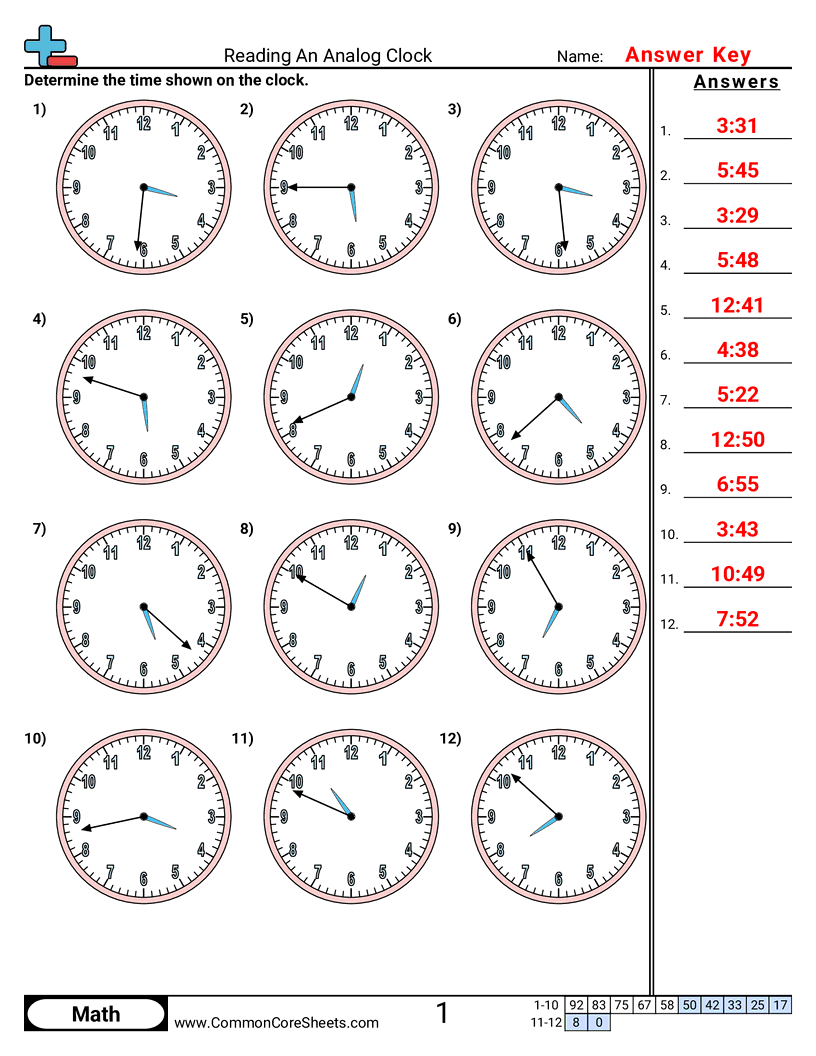
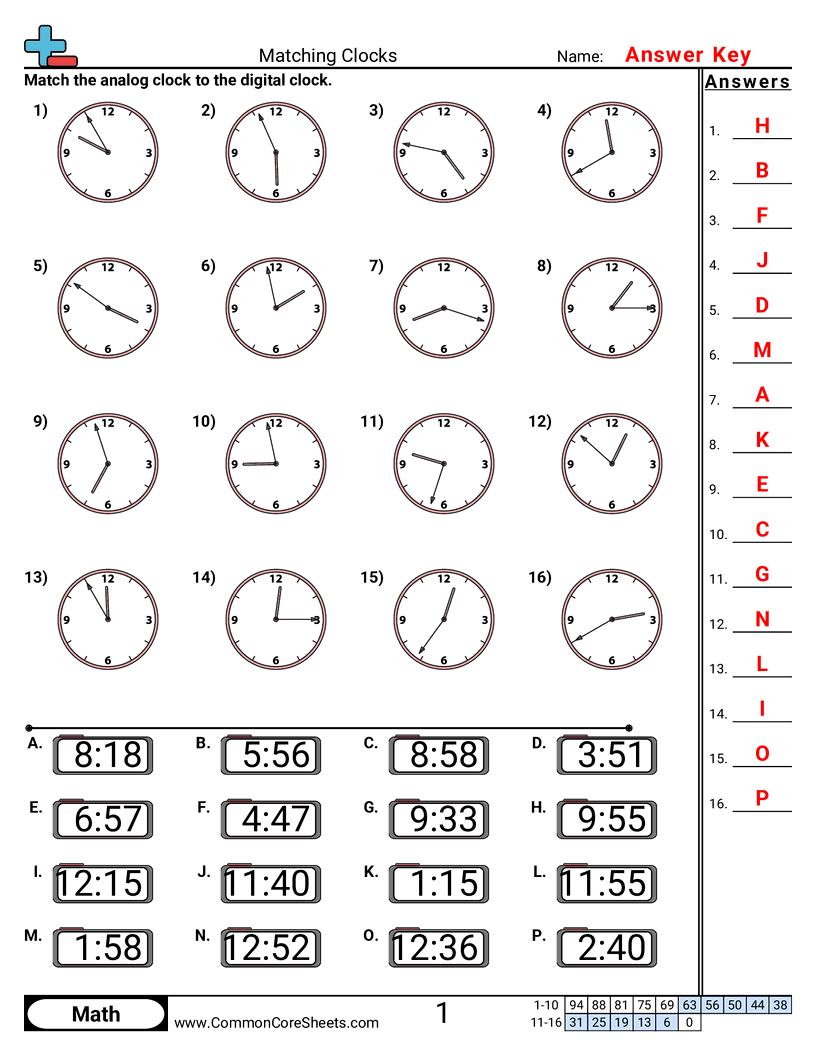
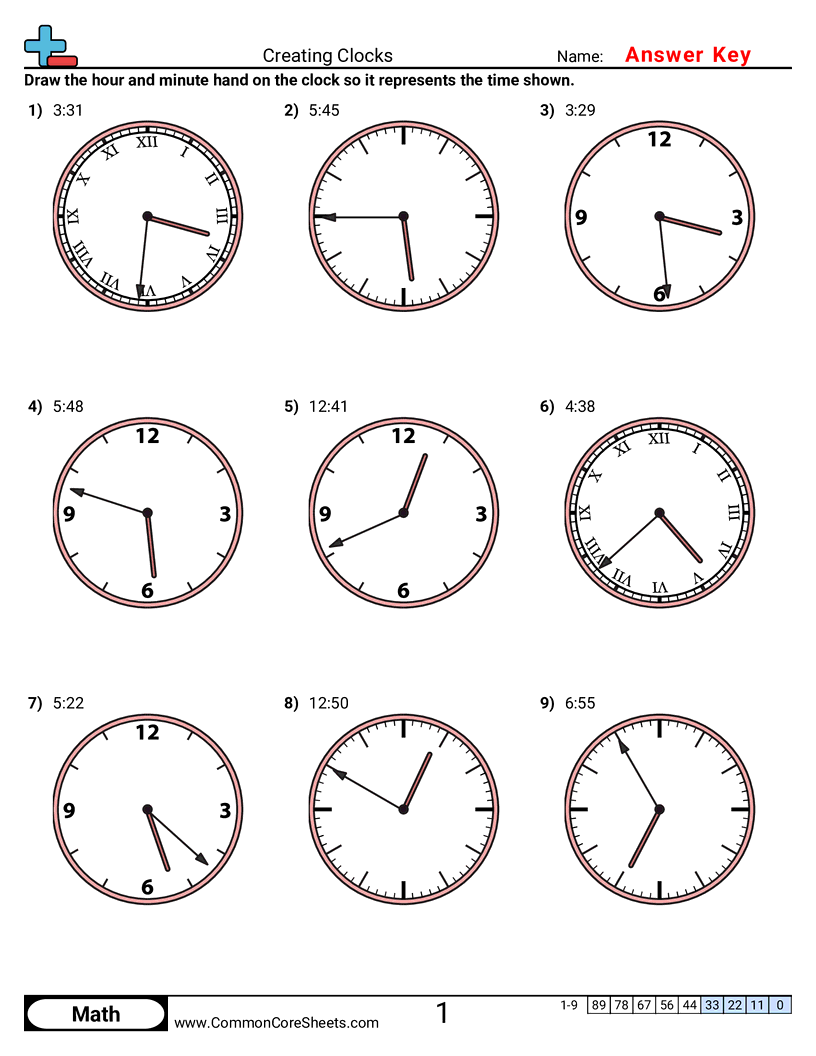
These worksheets build clock-reading skills across multiple levels. Students progress from identifying hour and minute hands and reading half-hour times, to reading clocks in 15-minute and 5-minute increments, and finally to reading exact times to the nearest minute. Each level includes reading analog clocks, matching analog to digital times, and drawing hands on clock faces. Aligned with first and second grade standards.
2md7
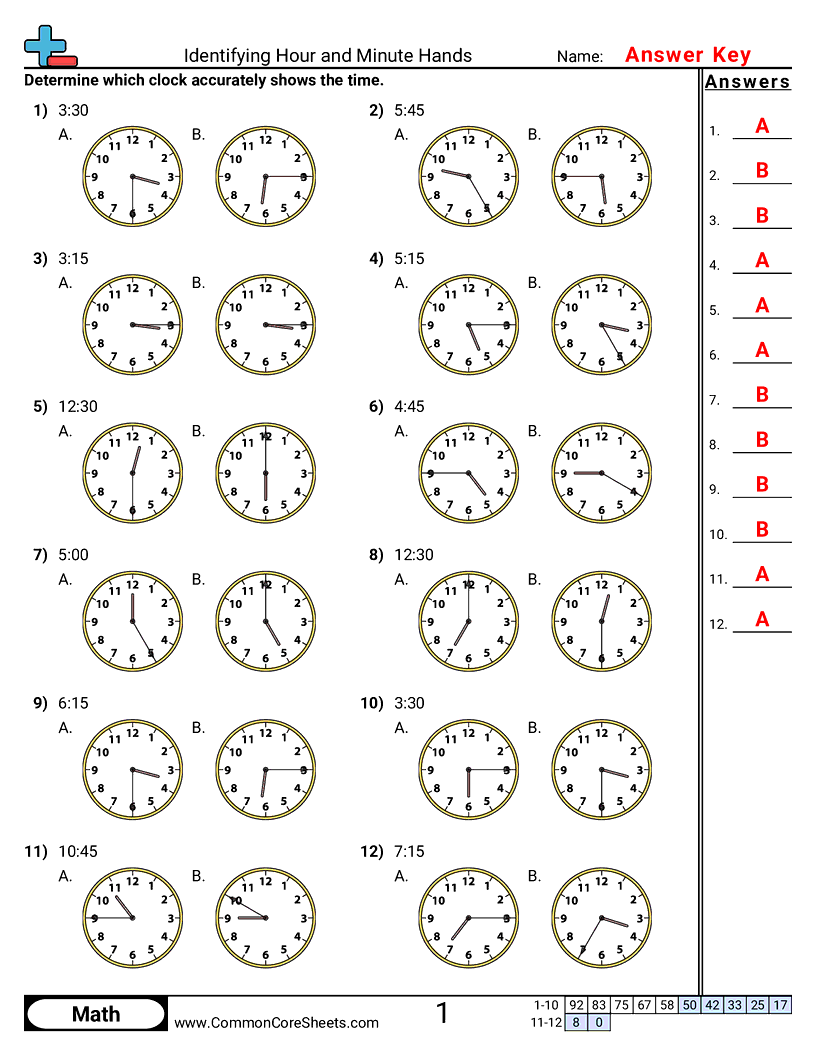
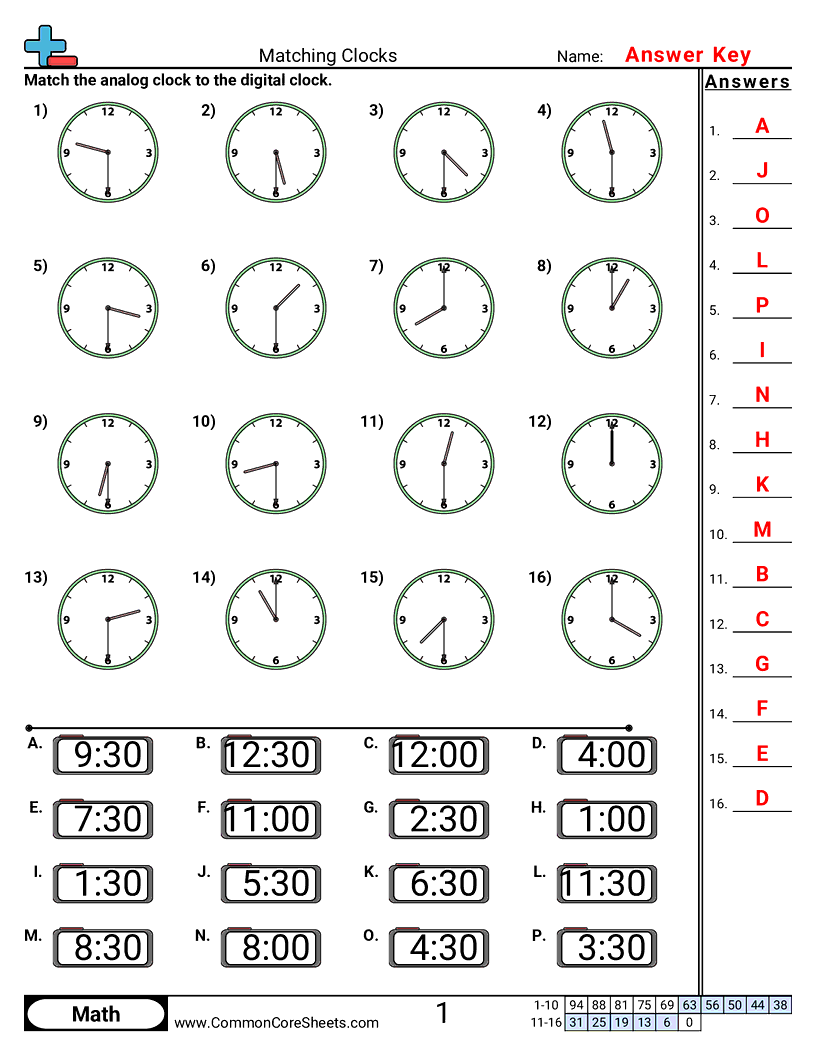
Tell which hand is the hour hand and which is the minute hand on an analog clock. Use the hour hand to choose the correct hour on a digital time. Use the minute hand to choose the correct minutes on a digital time. Match an analog clock face to the digital time that shows the same moment.
1md3
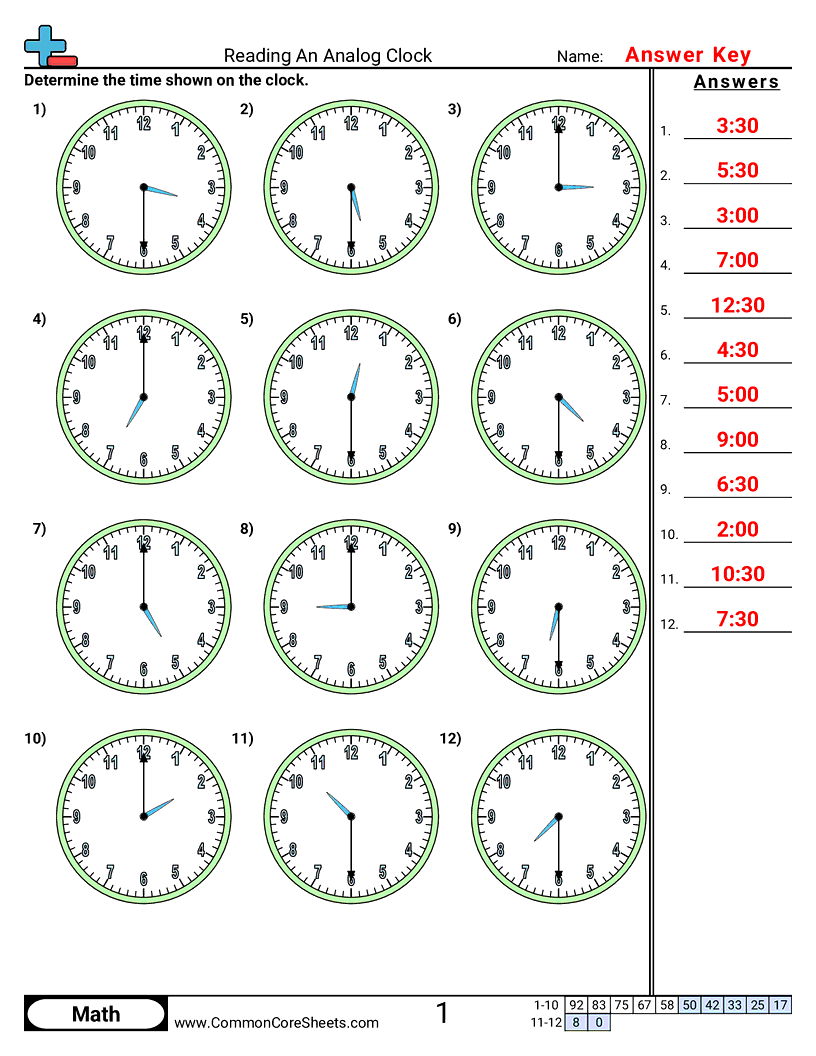
Read an analog clock to tell what time it is to the nearest half hour. Use the hour hand and minute hand together to decide whether the time is on the hour (:00) or half past (:30). Write the time shown on a clock using numbers and a colon (like 6:00 or 6:30). Notice that when the minute hand points to 6, it means 30 minutes past the hour.
1md3
Read an analog clock when the minute hand is on the 6 to tell the half hour. Match an analog clock time to the correct digital time. Notice the difference between times like 3:00 and 3:30 by looking at the hands. Use the hour hand’s position to decide which hour comes with the :30 time.
1md3
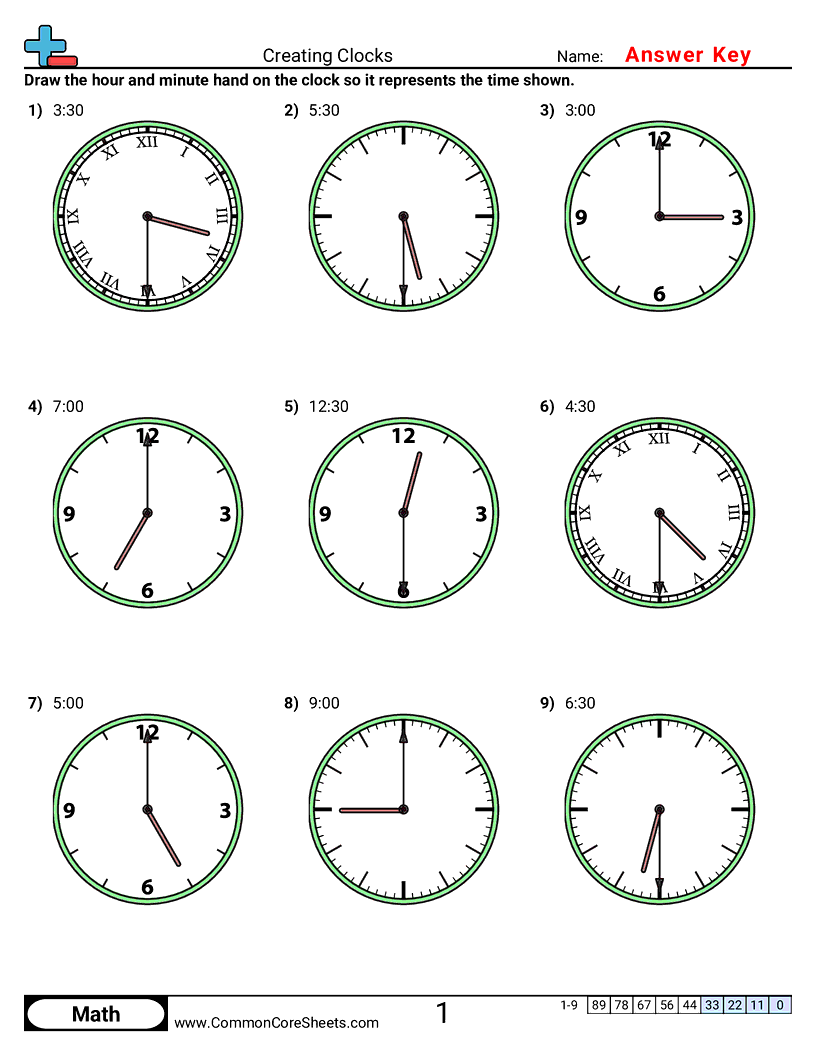
Practice showing a given time on an analog clock by drawing the hour and minute hands. Learn what the minute hand looks like at :30 and place it correctly on the 6. Decide where the hour hand should be when it is halfway between two numbers.
2md7
Read the time on an analog clock when the minute hand is on a 5-minute mark. Use the minute hand to count minutes by fives around the clock face. Use the hour hand’s position to decide which hour to say, especially when it’s between two numbers. Write the time using numbers with a colon (like 6:05 or 8:40).
2md7
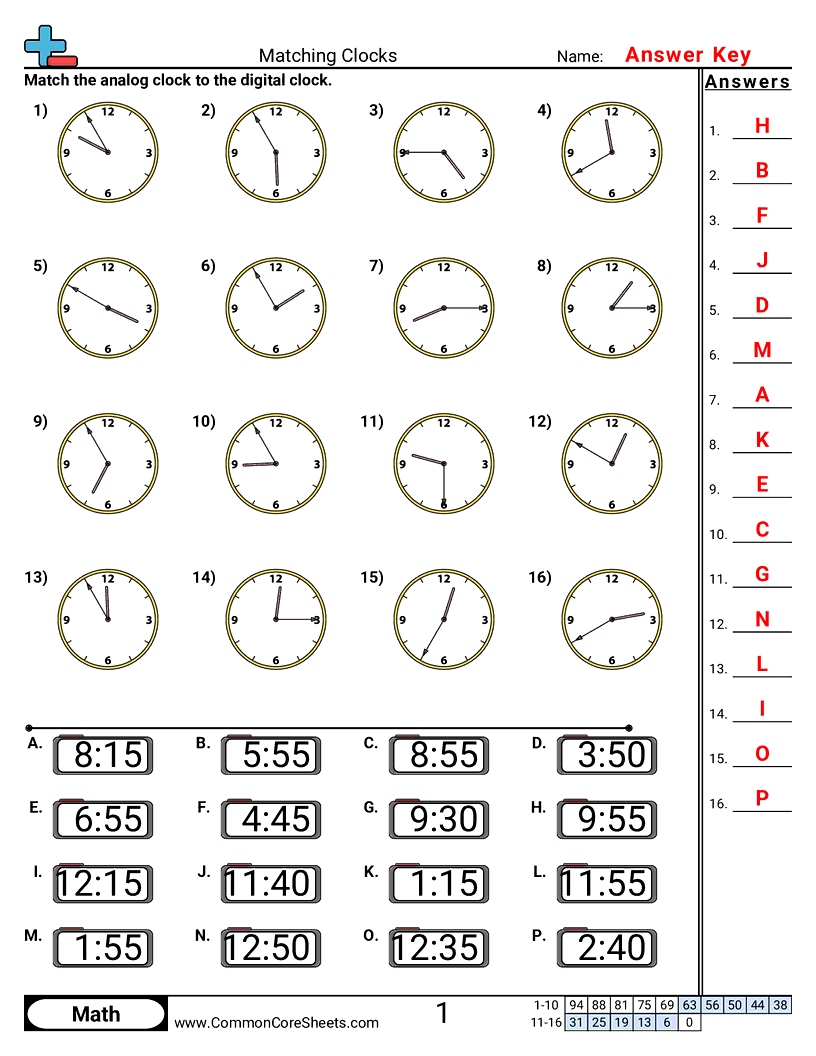
Read an analog clock to tell time to the nearest 5 minutes. Match the minute hand position to the correct minutes past the hour (5, 10, 15, and so on). Match an analog clock to the correct digital time.
2md7
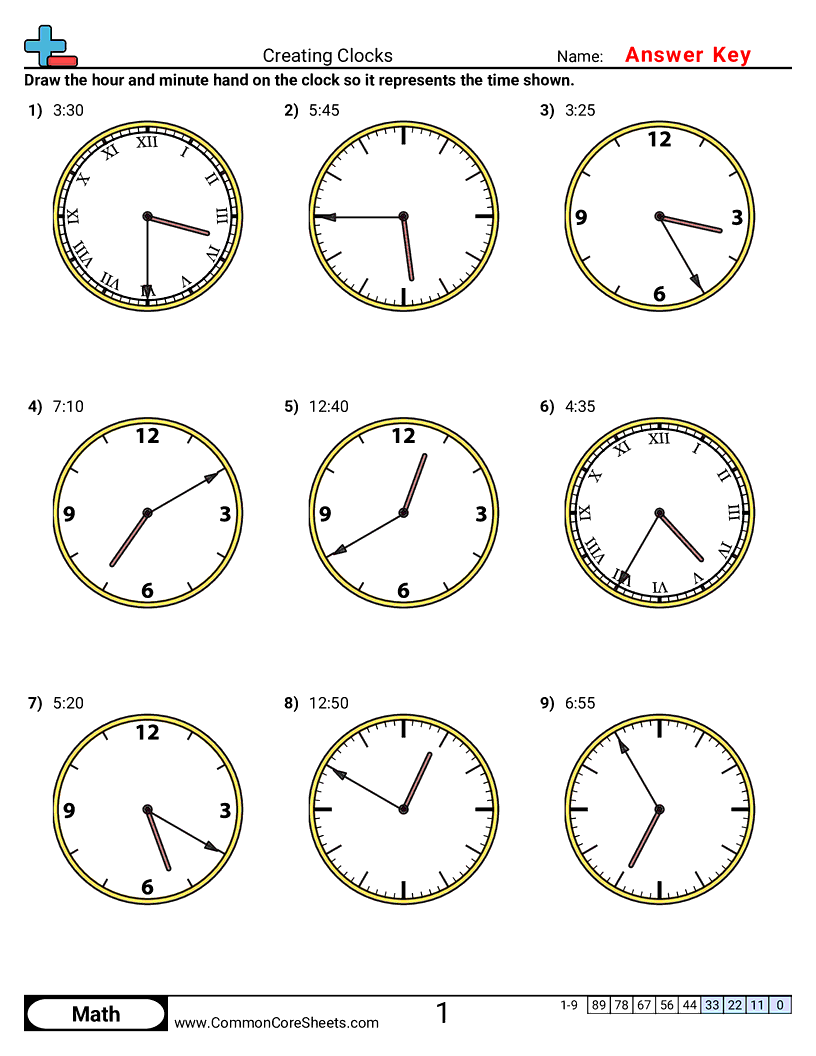
Practice showing a given time on an analog clock by drawing the hour and minute hands. Learn to place the minute hand correctly for times that land on 5-minute marks (like :05, :10, :15, and so on). Practice putting the hour hand in the right spot between numbers when it’s not exactly on the hour.
2md7
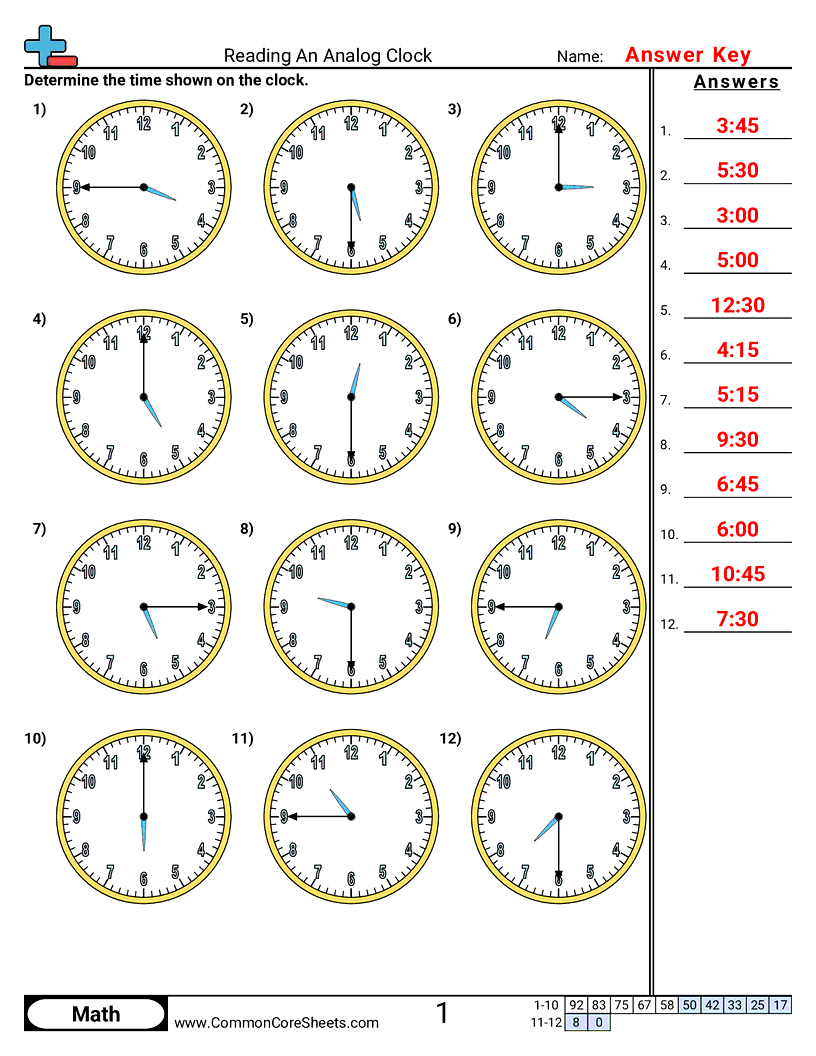
Read an analog clock to tell what time it is to the nearest 15 minutes. Use the hour hand’s position to decide which hour to say when the time is past the hour.
2md7
Read an analog clock to tell time to the nearest 15 minutes. Match a clock face to the correct digital time. Use the minute hand position to decide if the time is :00, :15, :30, or :45. Notice how the hour hand moves between numbers when it is quarter past, half past, or quarter to.
2md7
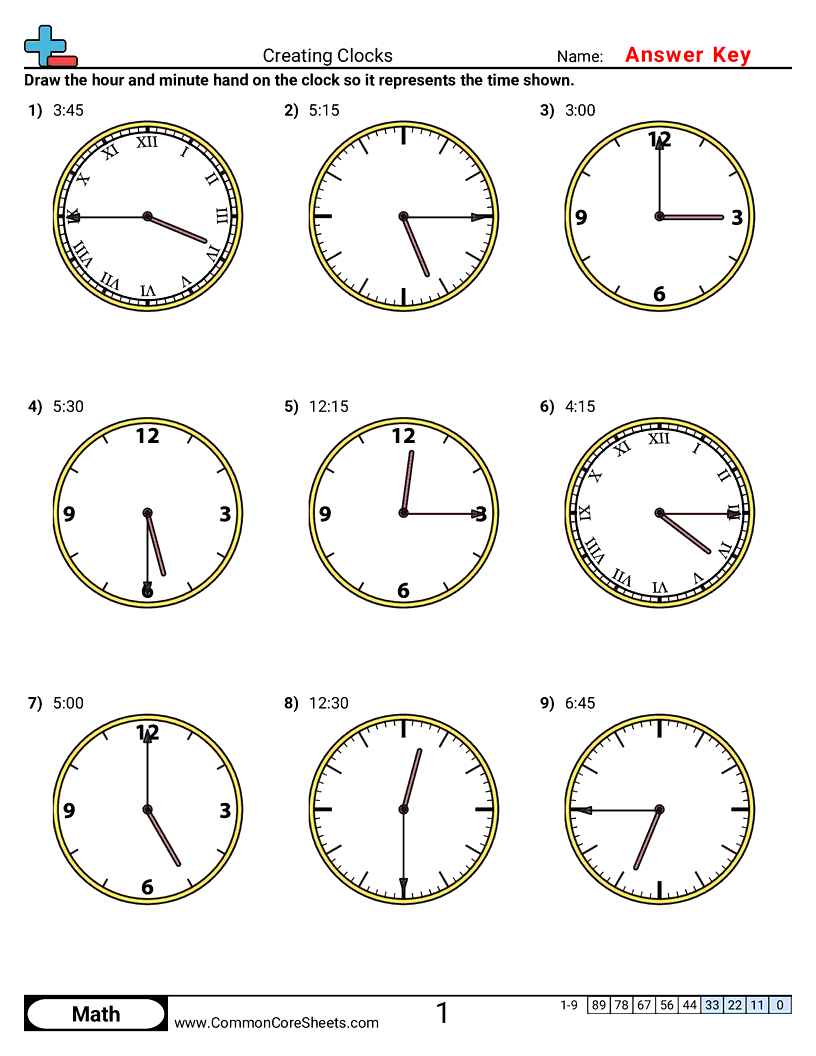
Practice drawing the hour and minute hands to match a given time on an analog clock. Learn how the minute hand points to 0, 15, 30, and 45 minutes around the clock face. Tell the difference between the hour hand and the minute hand and place each one correctly.
Read an analog clock to tell the exact time to the nearest minute. Use the minute hand to count minutes around the clock face, including times that are not on the 5-minute marks. Use the hour hand position to choose the correct hour when the minute hand is between numbers. Write the time correctly using hours and minutes (like 6:11).
Read an analog clock and say the exact time to the minute. Match the hour and minute hands to the correct digital time. Count minutes around the clock face using the minute marks. Notice when the hour hand is between numbers and choose the correct hour.
Practice showing an exact time on an analog clock by drawing the hour and minute hands. Learn to place the minute hand correctly for any minute from 00 to 59. Practice putting the hour hand in the right spot between numbers when it’s not exactly on the hour.
Determining Starting Time
Link
About these worksheets
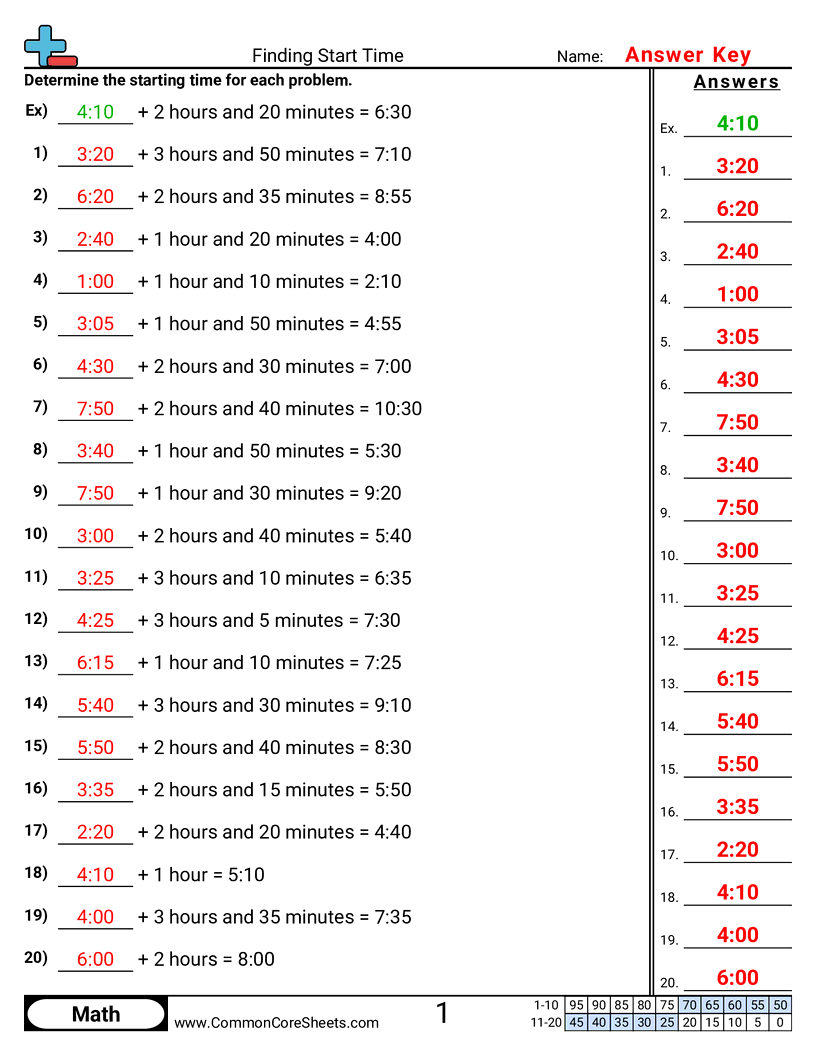
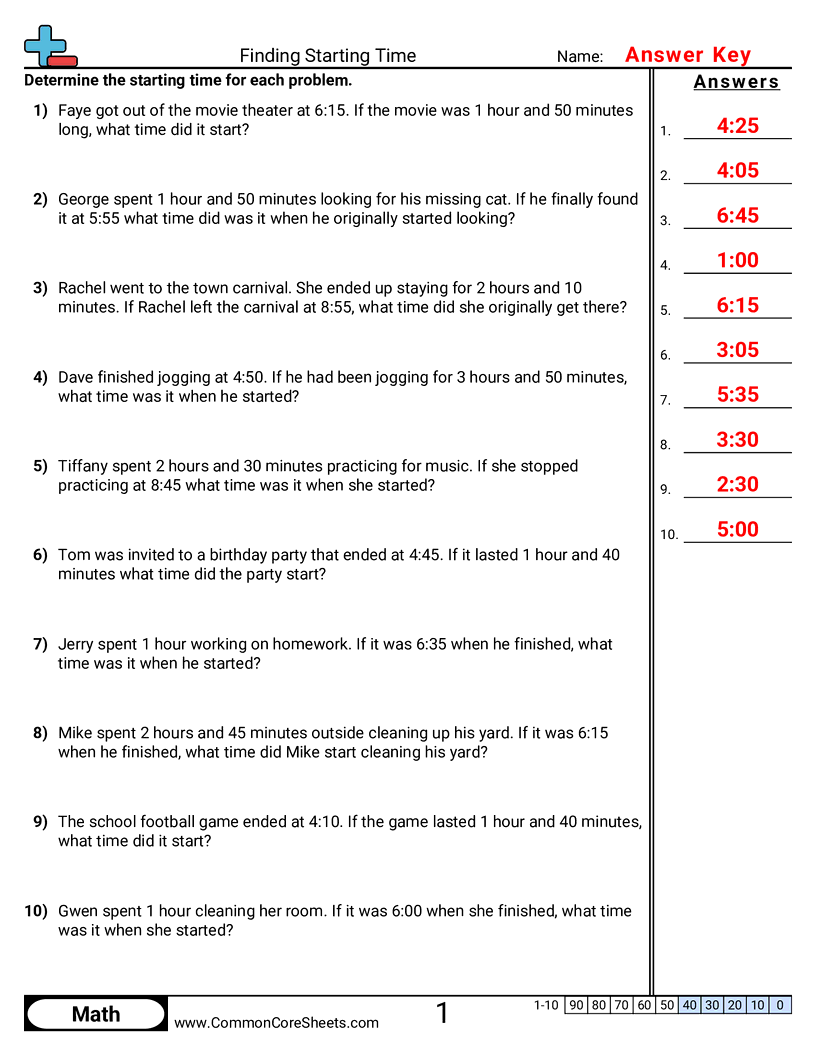
Students practice finding the start time when they know the end time and how long an activity lasted. Worksheets include numeric problems, number line models, and table formats, all requiring students to subtract elapsed time from an ending time, including problems that cross the hour. Aligned with third grade standards.
3md1
Find the start time when you know the end time and how long something lasted. Use subtraction to take away elapsed time from a given time. Keep track of time when crossing from one hour to the previous hour.
3md1
Figure out what time something started when you know the ending time and how long it lasted. Subtract minutes and hours on a clock, including when you have to cross an hour.
Use a number line to count backward from an end time to figure out the start time. Break an elapsed time into hours and minutes and subtract it step by step.
Find what time an activity started when you know the end time and how long it lasted. Subtract minutes and hours on a clock, including when you have to cross an hour. Use a consistent elapsed time to work through several start-time questions accurately.
Determining Elapsed Time
Link
About these worksheets
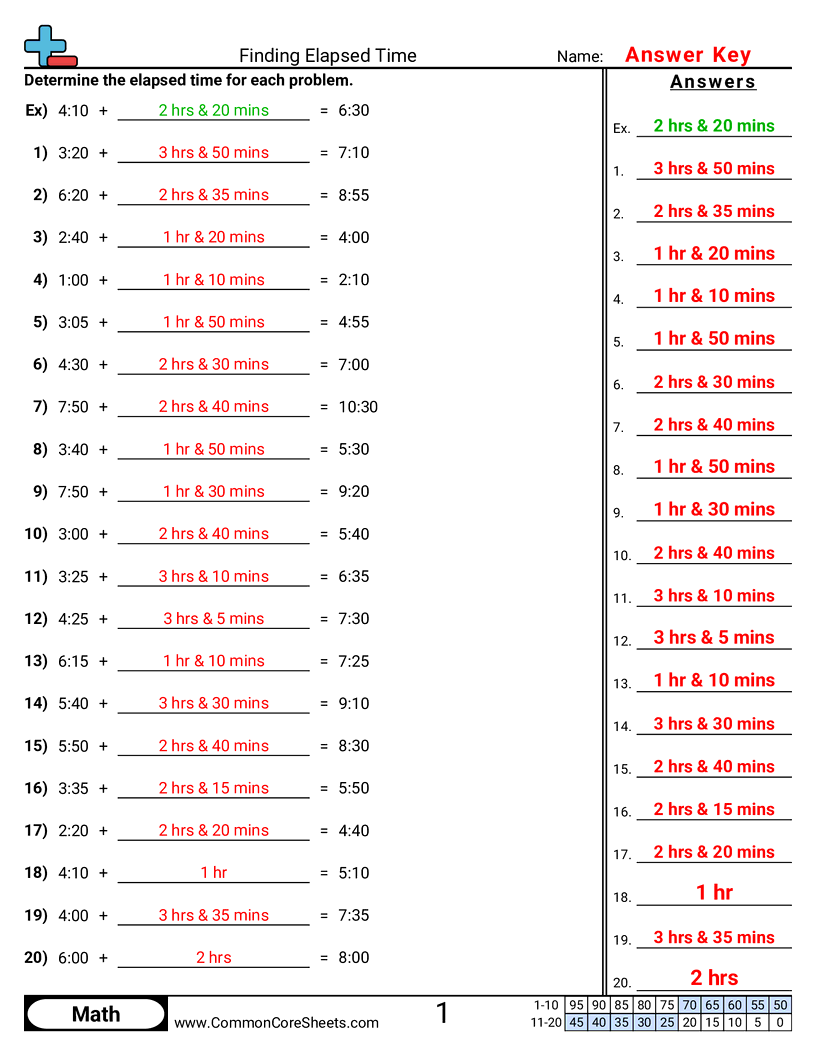
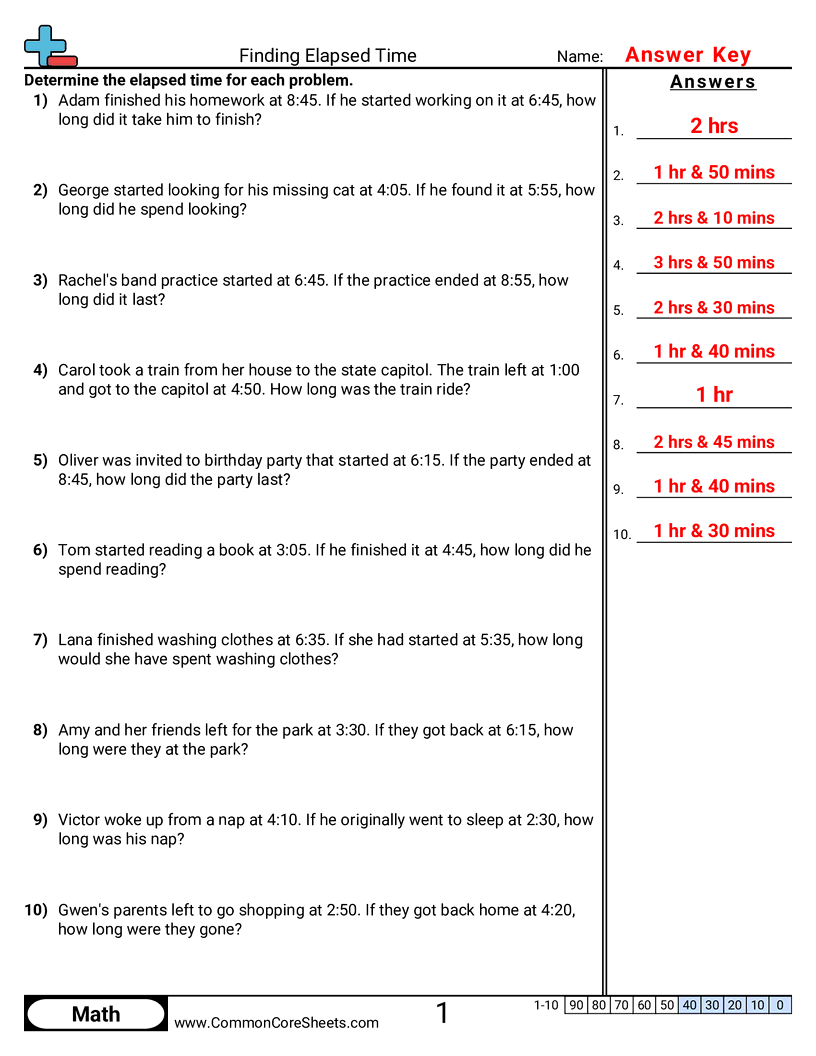
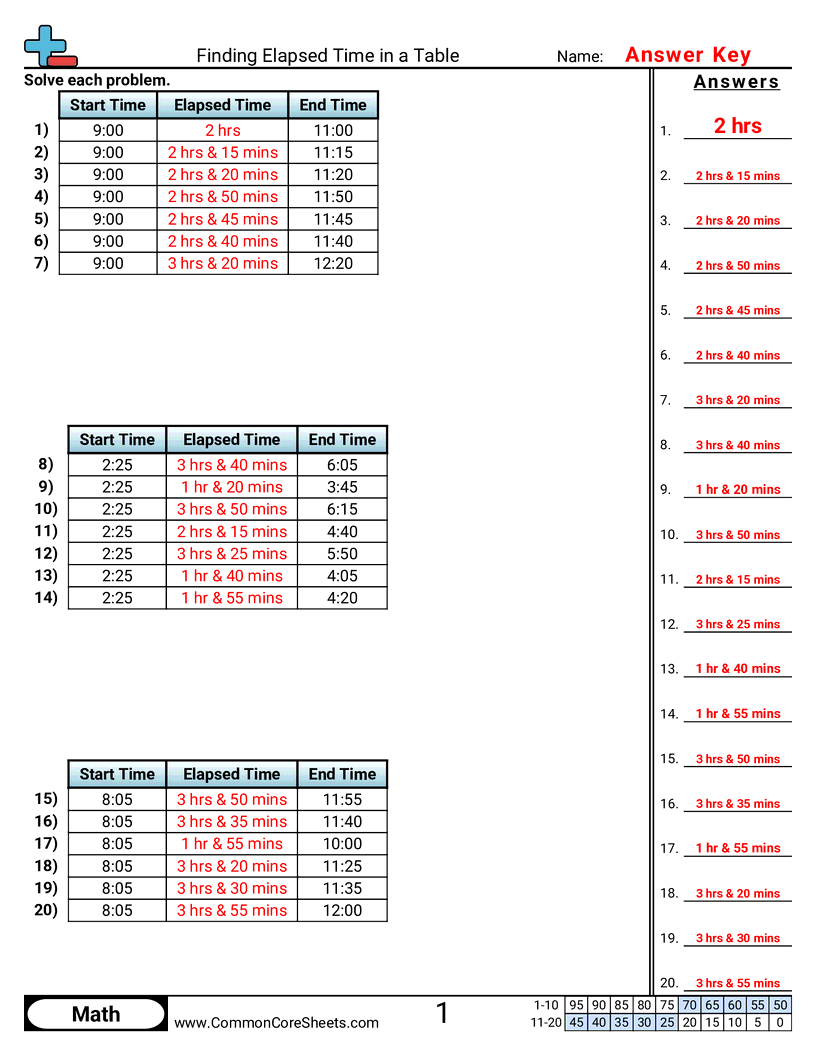
These worksheets develop the ability to calculate elapsed time — how much time has passed between a start and end time. Students work with numeric problems, number line models, and table formats, counting forward in hours and minutes to find the duration. Aligned with third grade standards.
3md1
Figure out how much time has passed between a start time and an end time. Count forward in hours and minutes to find elapsed time.
3md1
Figure out how much time has passed between a start time and an end time when the minutes change by 5s.
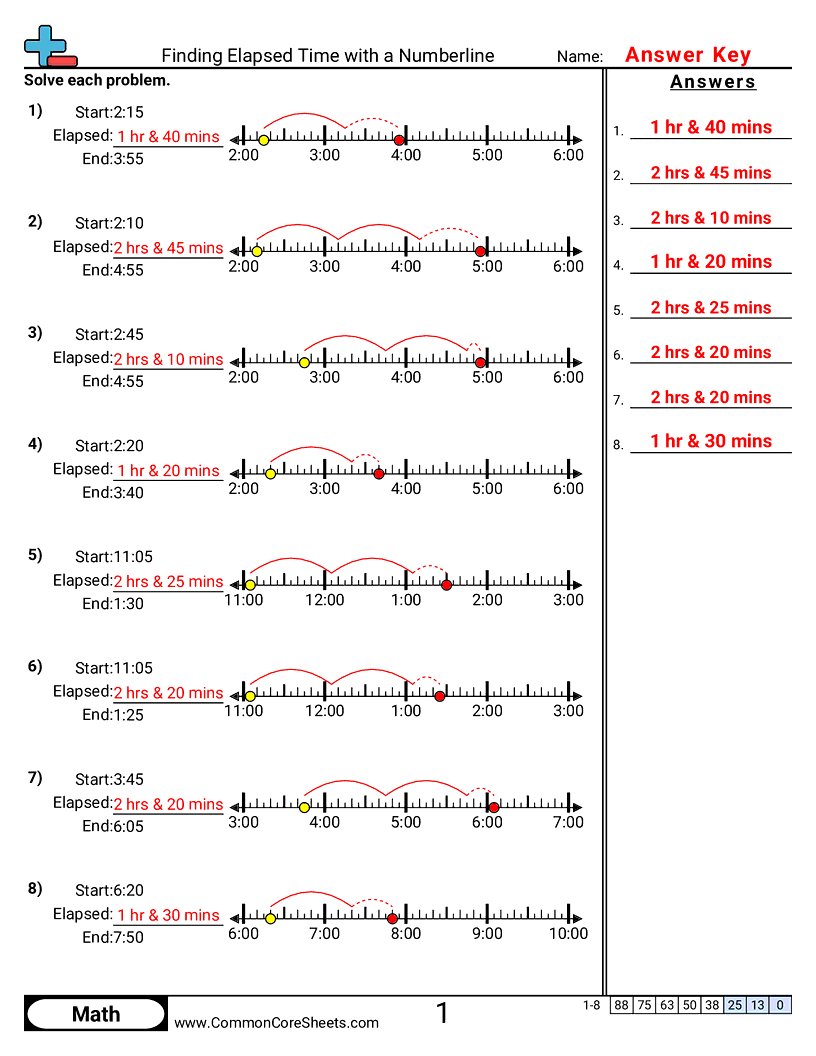
Find how much time passes from a start time to an end time by counting forward on a number line. Break an elapsed-time problem into smaller jumps of hours and minutes to make it easier to solve. Read and use time labels on a number line to keep track of where you are as you count.
Find how much time passes between a start time and an end time. Count forward in hours and minutes to track time across a schedule. Read and use information from rows and columns in a time chart.
Determining Ending Time
Link
About these worksheets
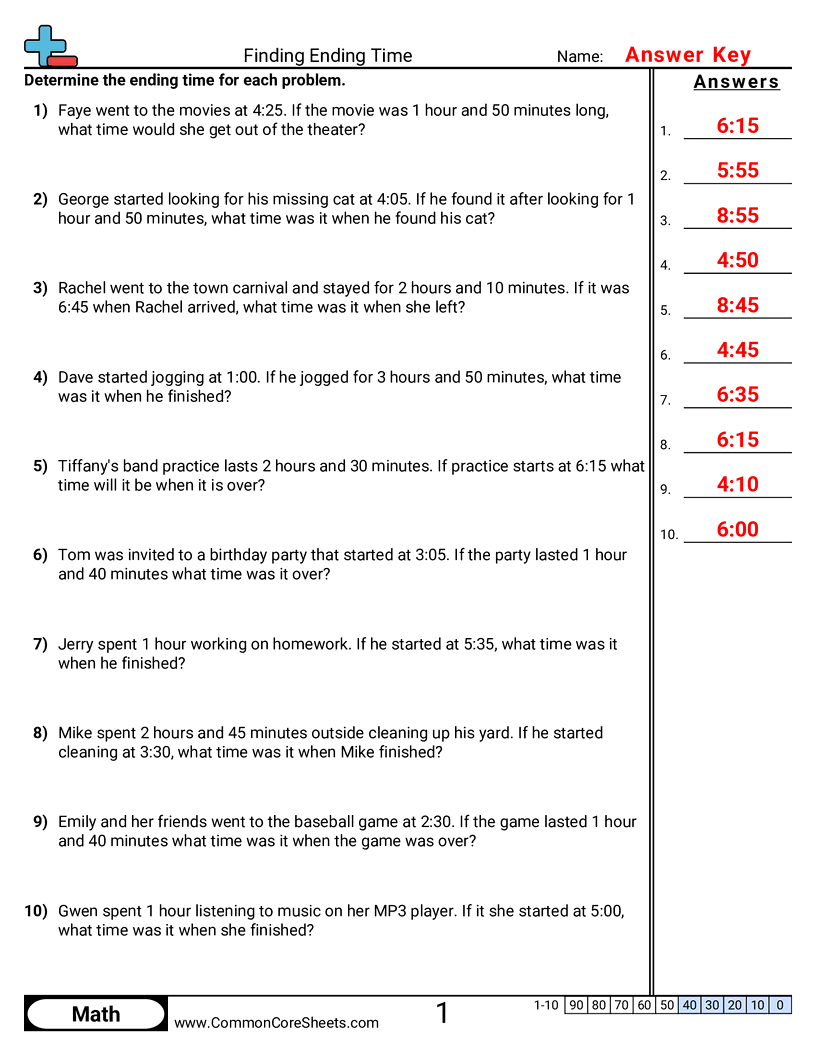
Students practice finding the end time when they know the start time and duration. Worksheets include numeric problems, number line models, and table formats, all requiring students to add elapsed time to a starting time, including problems where minutes cross the hour. Aligned with third grade standards.
3md1
Find the time something ends when you know the start time and how long it lasts. Count forward by minutes and hours, including when the time crosses to a new hour.
3md1
Figure out what time an activity will end when you know the start time and how long it lasts. Handle time problems that cross over to the next hour (like 2:50 plus 20 minutes).
Use a number line to add minutes and hours to a starting time. Count forward in jumps to find the ending time after some time has passed. Keep track of when the time crosses to the next hour while counting on. Read and write the correct ending time in hours and minutes.
Find the ending time when you know the start time and how long something lasts. Handle times that cross to the next hour when the minutes go past 60. Read a schedule-style table and use the row and column information to choose the right times.
About these worksheets
These worksheets cover a variety of additional time skills. Activities include using rounding strategies to find time, converting between hours and minutes, identifying common time phrases like "half past" and "quarter to," converting hours to days and days to weeks, reading calendars, and solving calendar word problems. Aligned with third grade and general time concepts.
3md1
Practice adding hours and minutes to a starting time to find a new time Use a rounding strategy — round the minutes to the nearest hour, add, then adjust by subtracting the extra minutes Work with elapsed time problems that involve carrying minutes past 60
3md1
Convert hours into minutes by multiplying by 60. Convert minutes into hours by dividing by 60.
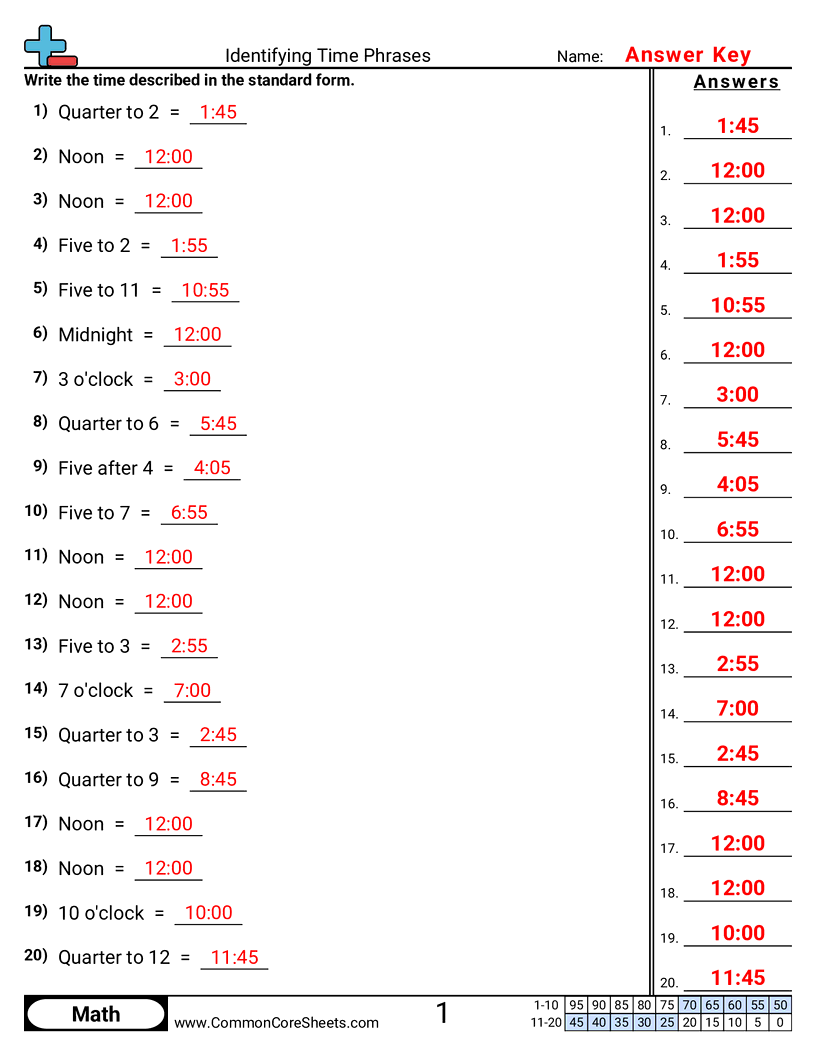
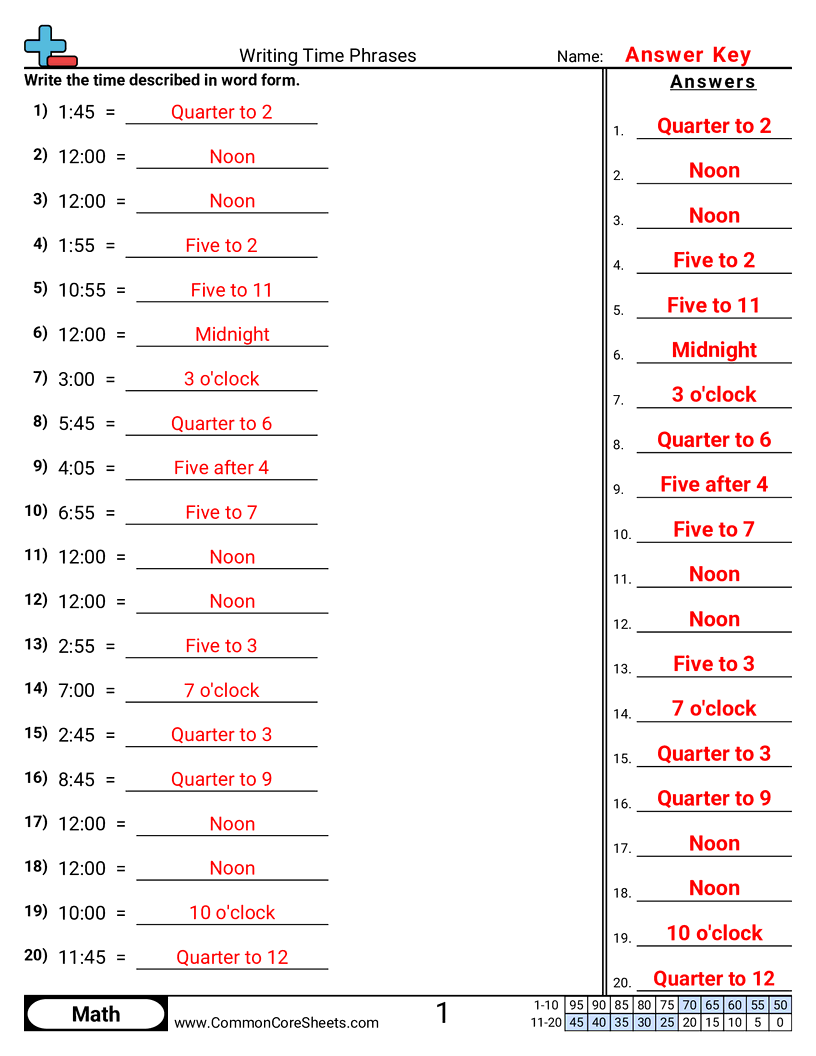
Recognize common time phrases like o'clock, half past, quarter past, and quarter to. Figure out whether a phrase means minutes after the hour or minutes before the next hour. Match words like before, after, past, and to with the correct part of the clock. Translate a written time phrase into a specific time in hours and minutes.
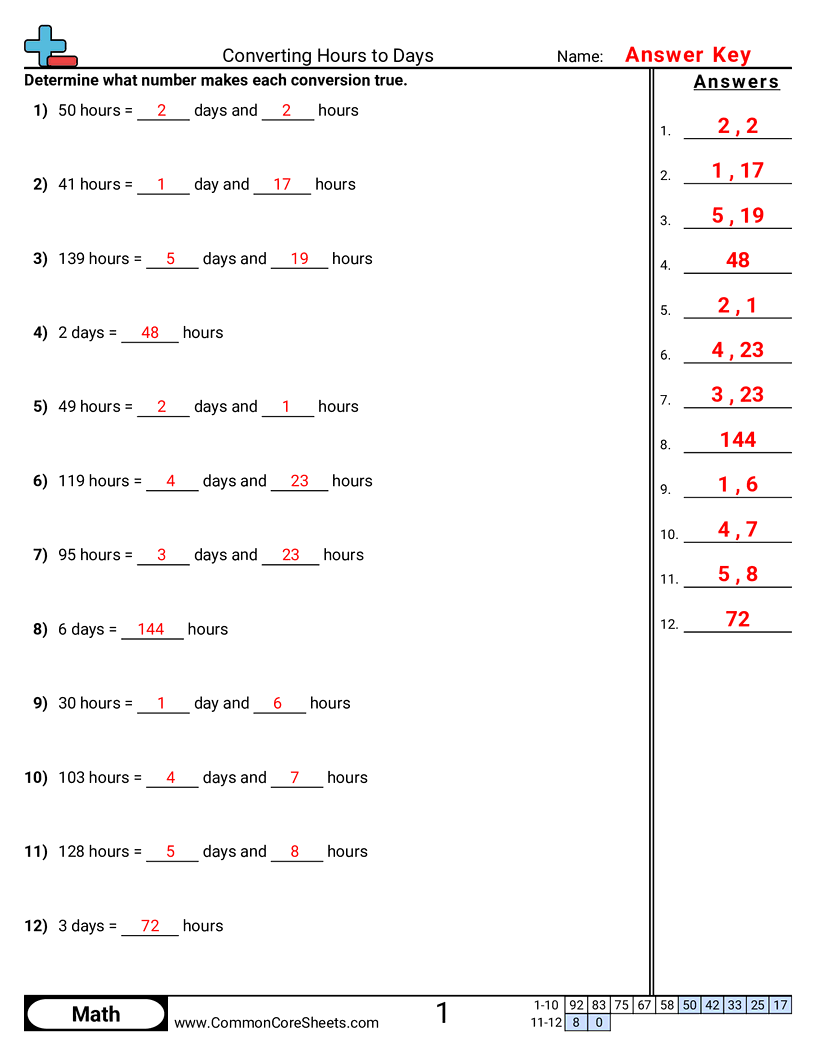
Convert hours into days by using the fact that 1 day equals 24 hours. Convert days into hours by multiplying by 24.
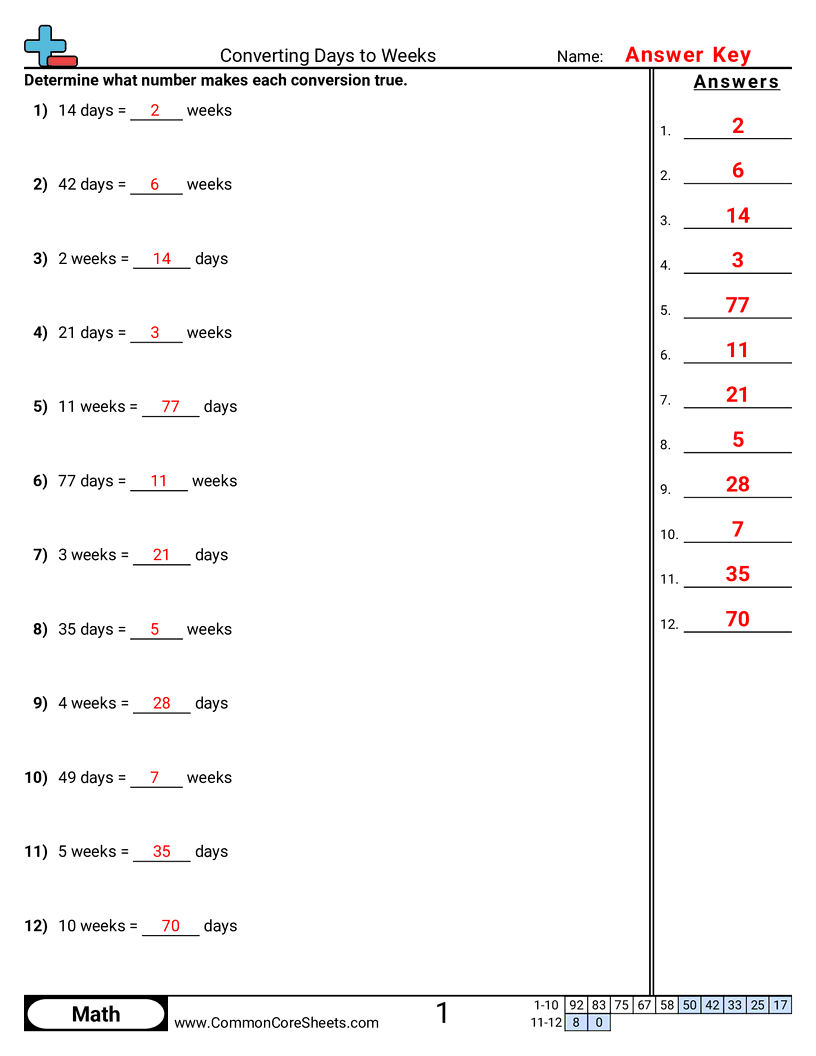
Convert a number of days into weeks by grouping days into sets of 7. Convert a number of weeks into days by counting 7 days for each week.
Find specific dates on a monthly calendar. Answer questions about what day of the week a date falls on. Count forward or backward to figure out dates a certain number of days away. Tell how many days are between two dates on the calendar. Sort dates into weekdays and weekends.
Read calendar word problems and pull out the important date and time clues. Figure out what day or date it will be a certain number of days or weeks before or after a given date. Count how many days are between two dates to find elapsed time.
Advertisement