4md6 Worksheets
Measurement and Data
Geometric measurement: understand concepts of angle and measure angles.
6Measure angles in whole-number degrees using a protractor. Sketch angles of specified measure.
4md6
4md6

×
Description:
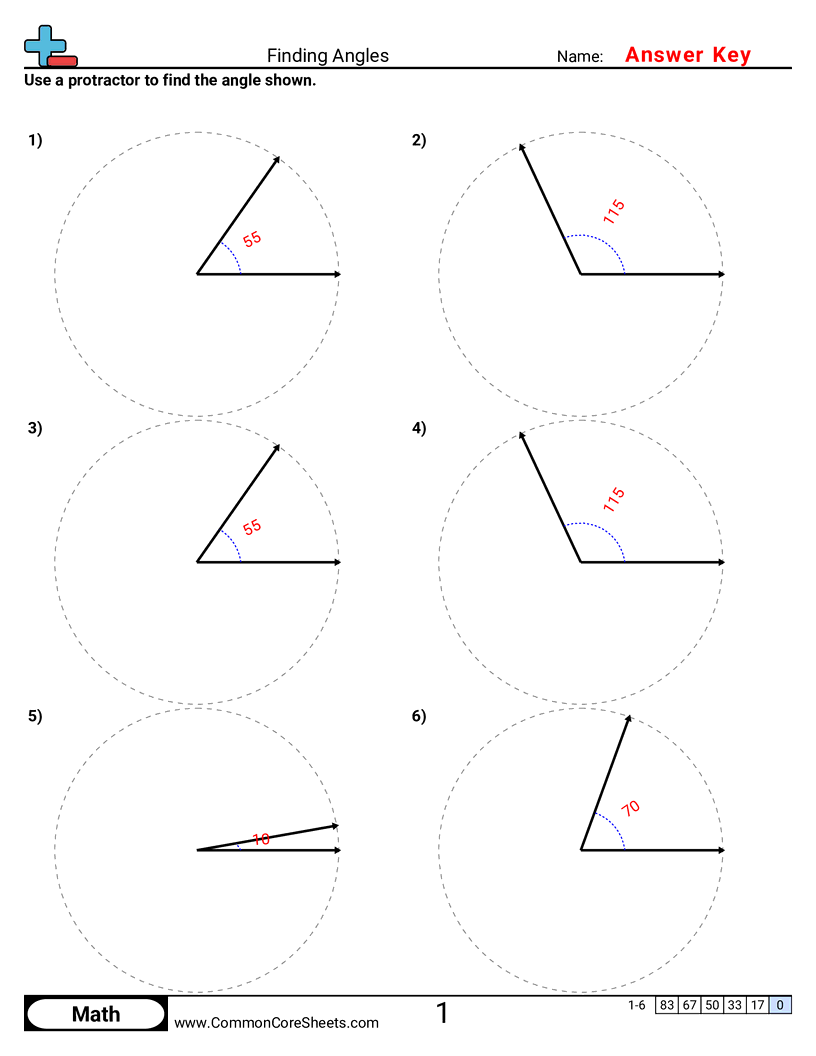
"This worksheet is designed to help children learn about creating angles in the subject of math. With 6 interactive problems featuring various degree measurements, kids can visualize and grasp the concept effectively. The versatile sheet can be customized according to different learning levels. Additionally, it can be converted into flashcards or implemented for distance learning, enhancing adaptability in any learning environment. A perfect tool for building a strong foundation in geometry."

×
Student Goals:
4md6

×
Description:
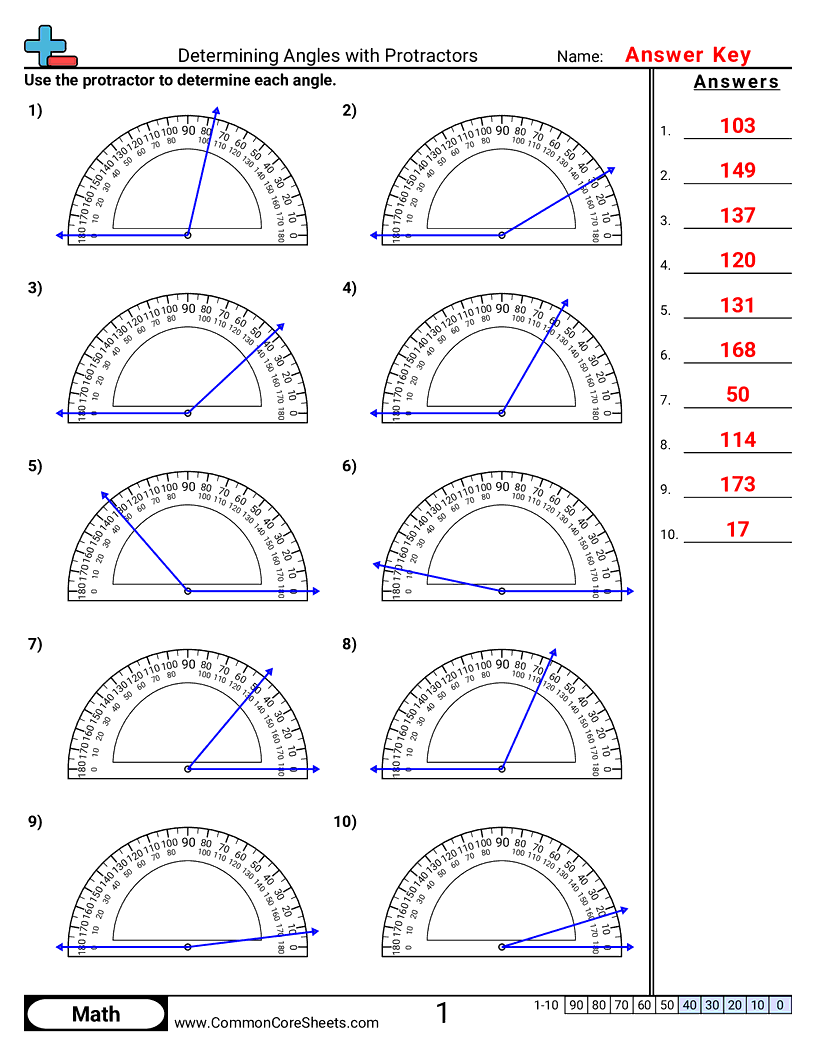
"This worksheet is designed to enhance children's math skills specifically in determining angles using protractors. It features ten problems with various angles to measure and recognize. Ideal for in-person or distance learning, it provides a customizable feature to suit different learning paces and styles. It can even be converted into flash cards for an interactive learning experience. A versatile tool in advancing mathematical understanding in children."

×
Student Goals:
Understanding of AnglesAfter completing this worksheet, students will gain a concrete understanding of what angles are, how they are formed, and how to identify them. They will discover that angles can be found everywhere, from the smallest molecular structures to vast celestial bodies. They will learn that angles are a fundamental concept in geometry and other branches of mathematics.Skill in Using ProtractorsThe competence in using protractors, an essential geometrical tool, is another expected accomplishment. A protractor, usually a semi-circle made from transparent plastic, measures angles. It helps in drawing angles with a certain measure and in determining the measure of existing angles. The students can accurately measure various angles, utilize protractors correctly, and understand the purpose and usefulness of this tool in practical and theoretical math problems.Improved Problem-Solving SkillsProblem-solving skills will be significantly improved once the students have finished the worksheet. This is because it entails determining angles, interpreting images, and deducting the logical steps to find solutions. The skill to tackle and solve problems can be a turning point in their cognitive development, affecting their ability to handle complex mathematical challenges later.Ability to Recognize PatternsRecognizing patterns in numbers and shapes is a fundamental skill in mathematics that this worksheet focuses on. As students analyze and compute angles, they will soon notice patterns such as how the size of an angle changes as they alter its degree measure. This ability to discern patterns and generalize them is crucial not just in math but in other areas of life as well.Advancement in Mathematical VocabularyThis worksheet will also help students expand their math vocabulary. After completing the exercises, they should be familiar with terms such as 'angle', 'protractor', 'degree', 'measure', and more. An understanding of these concepts will form a strong foundation for more advanced mathematical studies in the future.Increased Confidence in MathThe accomplishment of completing a worksheet on what could be a challenging topic can significantly boost students' confidence in their mathematical abilities. As they finish each problem, they'll gain assurance in their skills and their ability to tackle similar problems in the future. This self-confidence may even extend beyond the realm of mathematics and positively influence theirlearning journey overall.
4md6

×
Description:
"This worksheet is designed to develop children's mathematical skills by learning to determine angles using protractors. It features 10 problems that engage students in identifying angles, enhancing their understanding and proficiency in math. Suited for distance learning, users can customize this worksheet to their preference or even convert it into flashcards, making the learning experience flexible and interactive."

×
Student Goals:
Mathematical UnderstandingAfter completing the worksheet on 'Determining Angles with Protractors', students should have an enriched understanding of the concept of angles and their measurements. They should have developed a detailed comprehension of the protractor as a mathematical tool and its application in measuring different angles in degrees. This allows students to visualize and explore the theory of angles in a practical, interactive way.Analytical ThinkingThis exercise aids in cultivating the students' analytical thinking skills. Because each question requires identification and measurement of angles, it enhances their ability to analyze visual data. They are expected to have improved their spatial skills, focusing not only on abstract numbers but also on actual physical space and dimensions.Problem SolvingThe worksheet is contrived to build and refine the problem-solving abilities of the students. They should be comfortable interpreting the measurements of different angles and be able to solve mathematical problems regarding angles effectively and accurately. The practice of measuring different angles will demonstrate the variability and potential complexities, helping them develop a problem-solving mindset.Application of KnowledgeAccomplishing the worksheet ensures that students can apply garnered mathematical concepts to new and unfamiliar situations. This indicates that the teachings have been internalized and that students can apply their knowledge practically. This practical application of knowledge is integral to their mathematical progress.Precision and AccuracyBy determining angles with protractors, students are expected to develop their precision and accuracy skills. This means they should be able to effectively use a protractor to measure angles accurately and distinctly. This learning outcome extends beyond mathematics; precision and accuracy are life skills that apply to various forms of learning and everyday tasks.Confidence and ProficiencyOn successful completion of this worksheet, students should have gained enough confidence in the subject matter. Engaging with this resource should make children feel more proficient in the topic of angles and their measurements. The competence derived from this action-based learning can foster an overall interest and positive attitude towards learning mathematics.
4md6

×
Description:
"This worksheet is designed to engage children in understanding and identifying various angles through visual representation. Seeing as it’s in the subject category of math, the content ranges from simple to complex angles using visual diagrams. Comprising of six problems, each one can be customized for a child's specific learning pace. Moreover, the flexibility of the content allows it to be converted into flashcards for quick study or adopted for distance learning formats. This makes for an interactive, adaptable, and fun learning experience."

×
Student Goals:
Understanding AnglesAfter completing the 'Finding Angles' worksheet, students will develop a robust understanding of angles and their role in geometry. They will comprehend the concept of angles evidently and would be familiar with the terminologies associated with angles.Identifying AnglesStudents will be able to identify different types of angles confidently. They will have gained the skills to recognize right angles, acute angles, obtuse angles, straight angles, reflex angles, full angles, etc. This acquired knowledge will make them capable of distinguishing among distinct angles in day-to-day life and in diverse mathematical problems.Measuring AnglesThe completion of the worksheet awards students with the ability to measure angles using a protractor correctly. They will attain accuracy over time, promoting precision in their mathematical abilities.Solving ProblemsStudents will excel at solving problems involving angles. They will mature their skills in using angles to determine missing information and solve other geometry problems. They could approach and resolve advanced mathematical queries with self-assurance and proficiency.Analytical ThinkingBy completing the worksheet, students will polish their analytical thinking skills. They will be able to analyze diagrams, deconstruct them into recognizable parts, and figure out angles in various geometric shapes. This builds critical thinking and enhances their problem-solving approach.Application of KnowledgeStudents will learn to apply their knowledge of angles not just in math but across subjects. For instance, understanding the basics of angles will assist them in subjects like physics and engineering in the future. Moreover, they could apply this information in real-life situations which reinforces their all-round development and learning.Confidence in Math AbilitiesAfter accomplishing the worksheet, students will feel a significant increase in their confidence in math abilities. Consistent practice with such worksheets enforces their foundation, leading them to become more comfortable with more complex mathematical problems.