transforming on a coordinate plane Worksheets
Free grid worksheets with answer key. No login or account needed. From reading a coordinate plane to graphing positive and negative coordinates, we've got you covered. A grading column and quick grade scale maker grading a breeze and a modified pages help with lower level learners or when just introducing a topic. Great for teachers or for homeschool.
Browse Sheets By Problem Type
×
Transforming On a Coordinate Plane
About these worksheets
Students practice transforming shapes on the coordinate plane. Worksheets cover reflecting shapes across the x- and y-axes, rotating shapes by 90°, 180°, and 270°, translating shapes in any direction, and calculating slope using slope-intercept form. Aligned with eighth grade geometry standards.
8g3

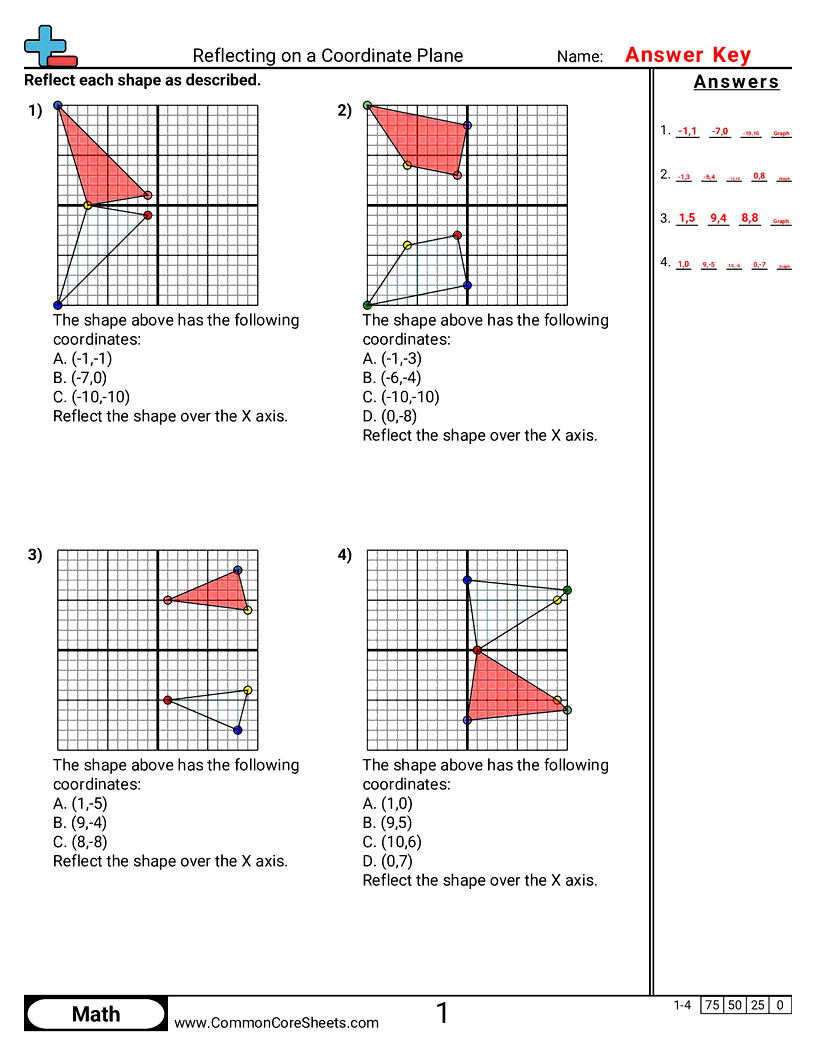
- Reflect a shape across the x-axis or y-axis to draw its mirror image.
- Use the x- and y-coordinates of points to plot the reflected shape in the right place.
- Apply the reflection rules to change coordinates correctly, like flipping the sign of x or y.
- Check that the original and reflected shapes are the same size and the same distance from the axis.
8g3

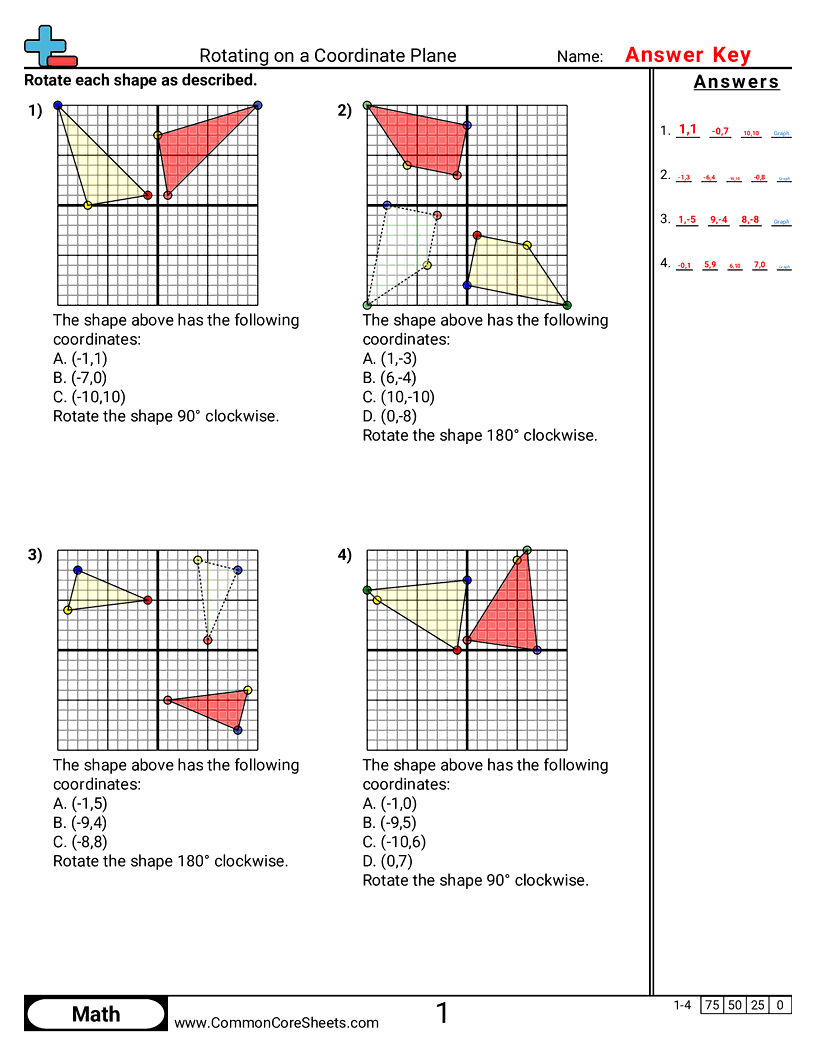
- Rotate a shape on a coordinate grid by 90°, 180°, or 270° in the direction given.
- Use the origin as the center of rotation and keep the shape’s size and orientation changes correct.
- Plot the new points after a rotation and connect them to redraw the rotated shape.
- Use rotation rules to predict how (x, y) coordinates change when turning a figure.
8g3

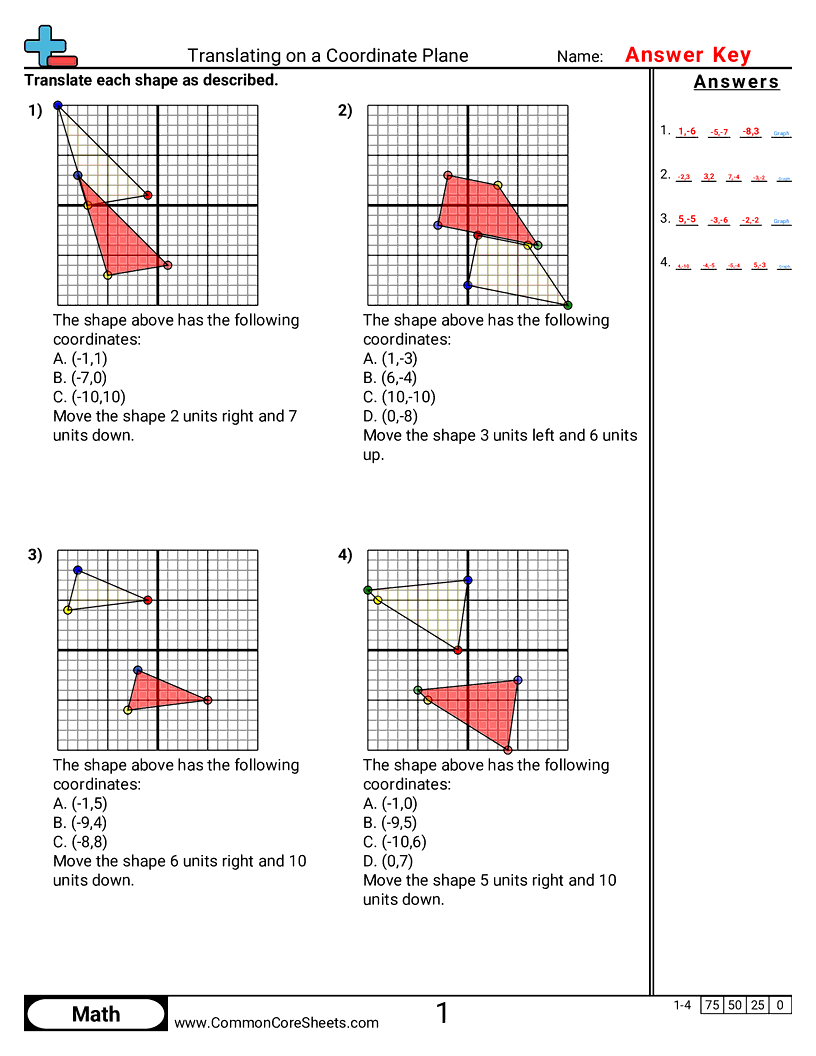
- Practice sliding a shape left, right, up, or down on a coordinate grid without turning it.
- Use ordered pairs (x, y) to track how each vertex moves during a translation.
- Follow a translation rule or vector (like (x + 3, y - 2)) to move a figure the correct amount.
- Plot the translated points and connect them to draw the new image in the right place.
- Check that the translated shape stays the same size and orientation as the original.
8sp3

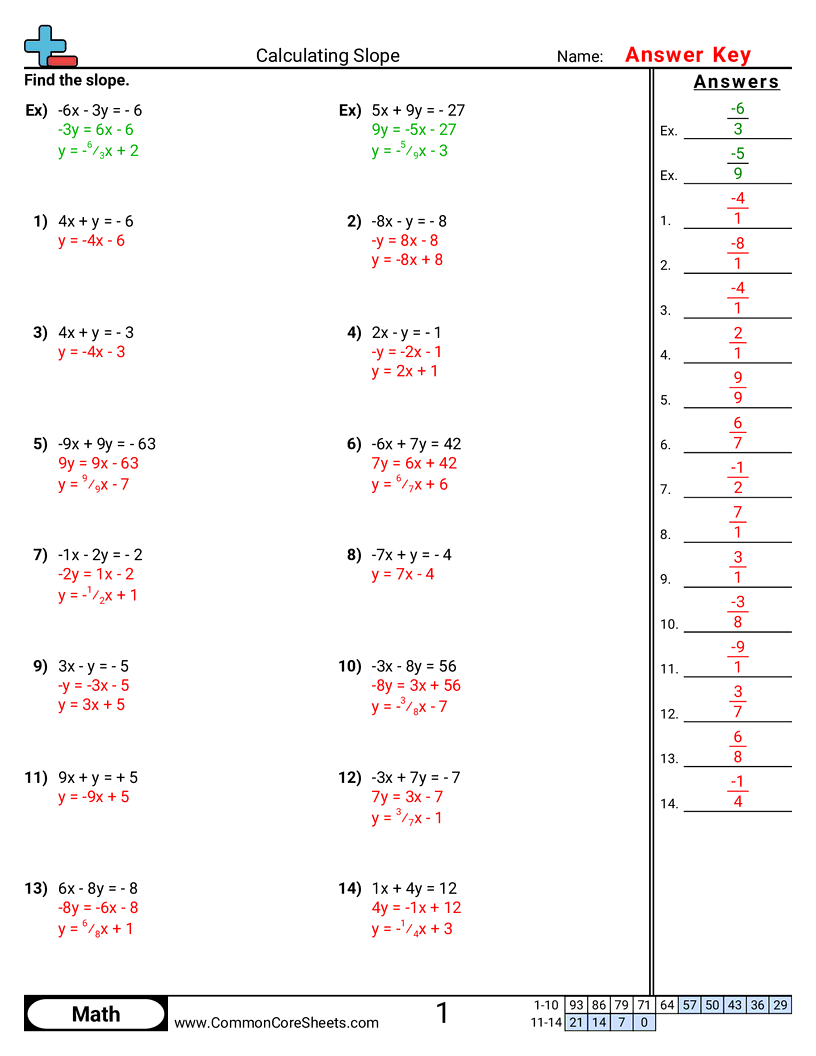
- Practice rearranging a linear equation into y = mx + b form to identify the slope
- Isolate y by moving the x term to the other side and dividing by the coefficient of y
- Work with slopes that are whole numbers, negative numbers, and fractions