Expanded Form Worksheets
This section provides free expanded form worksheets for grades 2-5, featuring 9 different worksheet types with 20 problems each. Students practice converting between numeric and expanded form using whole numbers from 100 to one million, plus decimals to thousandths.
×
About these worksheets
Students practice converting numbers between expanded form and standard (numeric) form. Worksheets cover whole numbers within 1,000 up to one million, as well as decimals to thousandths. Activities include standard expanded form (like 400 + 30 + 2) and expanded notation (using multiplication by place value). These resources align with second through fifth grade place value standards.
2nbt3
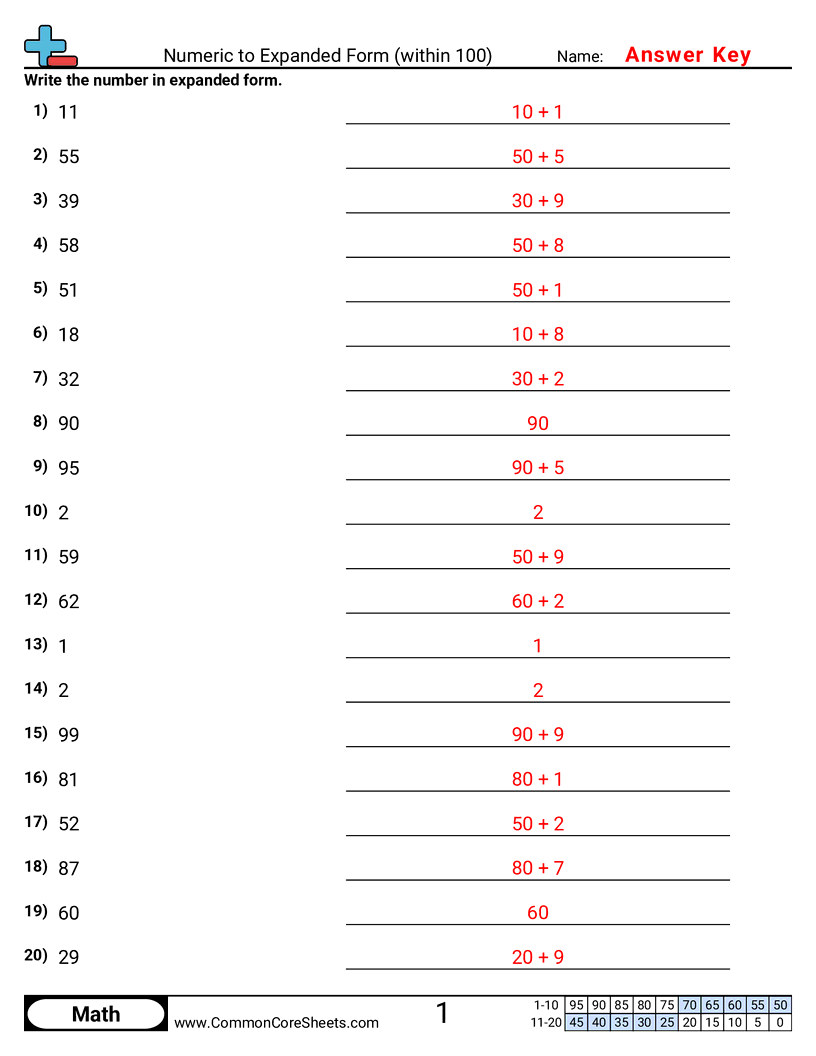
Break a two-digit number into tens and ones. Write a number in expanded form using addition (like 47 = 40 + 7). Use place value to explain what each digit in a two-digit number means. Check that the expanded form adds back to the original number.
2nbt3
Turn an expanded form like 300 + 40 + 6 into standard form. Use hundreds, tens, and ones to understand what each part of a number means. Add the parts in expanded form to build the whole number.
2nbt3
Break a number up into hundreds, tens, and ones. Write a number in expanded form as a sum (like 472 = 400 + 70 + 2). Use place value to decide which digits become hundreds, tens, and ones in the expanded form. Handle numbers that have a 0 in one place by leaving that part out or writing it as + 0.
4nbt2
Turn an expanded form like 400,000 + 30,000 + 200 + 5 into one number. Use place value to decide which digits belong in each spot from ones up to hundred-thousands. Combine the addends in expanded form to write the correct standard (numeric) form.
4nbt2
Break a number up into the value of each digit using place value. Write a number in expanded form as a sum of hundreds-thousands, ten-thousands, thousands, hundreds, tens, and ones. Use zeros as placeholders so missing place values are handled correctly in expanded form.
5nbt3a
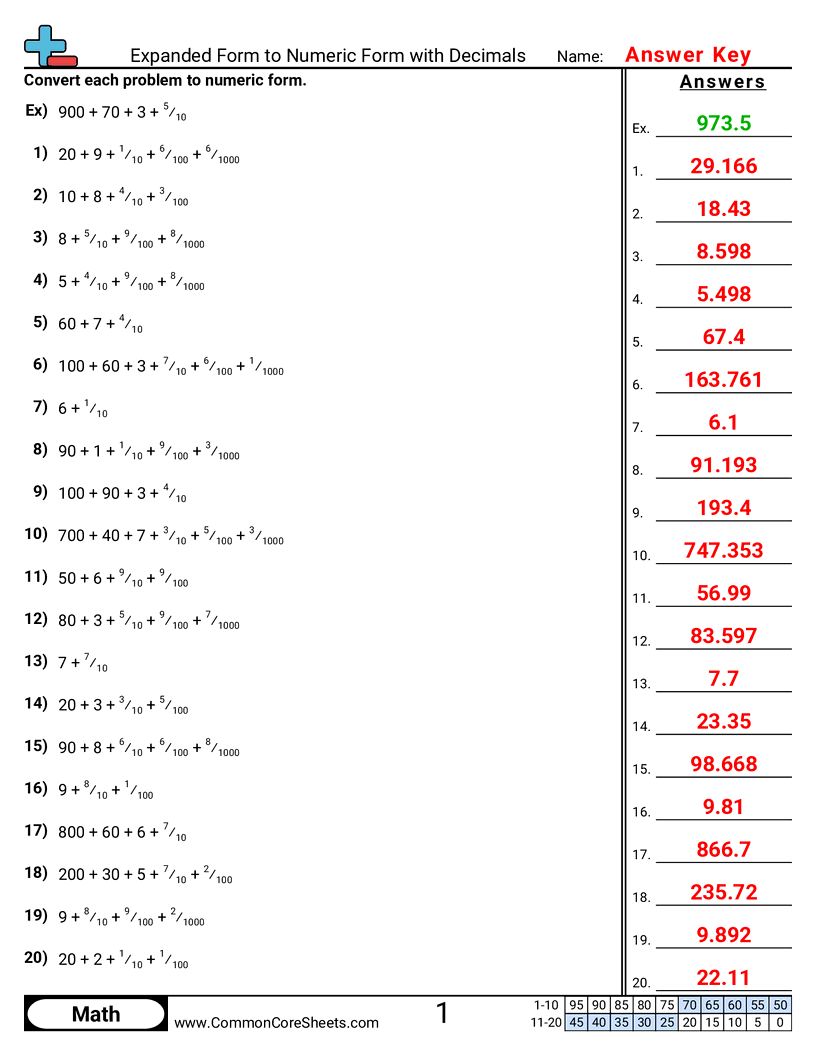
Use place value to decide which digits belong in the ones, tenths, hundredths, and thousandths places. Write decimals correctly with a decimal point and zeros when a place value is missing. Combine the parts of an expanded form by adding them to make a single decimal number.
5nbt3a
Turn an expanded notation expression into one decimal number. Use place value to decide which digits go in the ones, tenths, hundredths, and thousandths places. Combine whole-number parts and decimal parts correctly when writing the number in standard form. Write decimals with zeros in the right places when a place value is missing.
5nbt3a
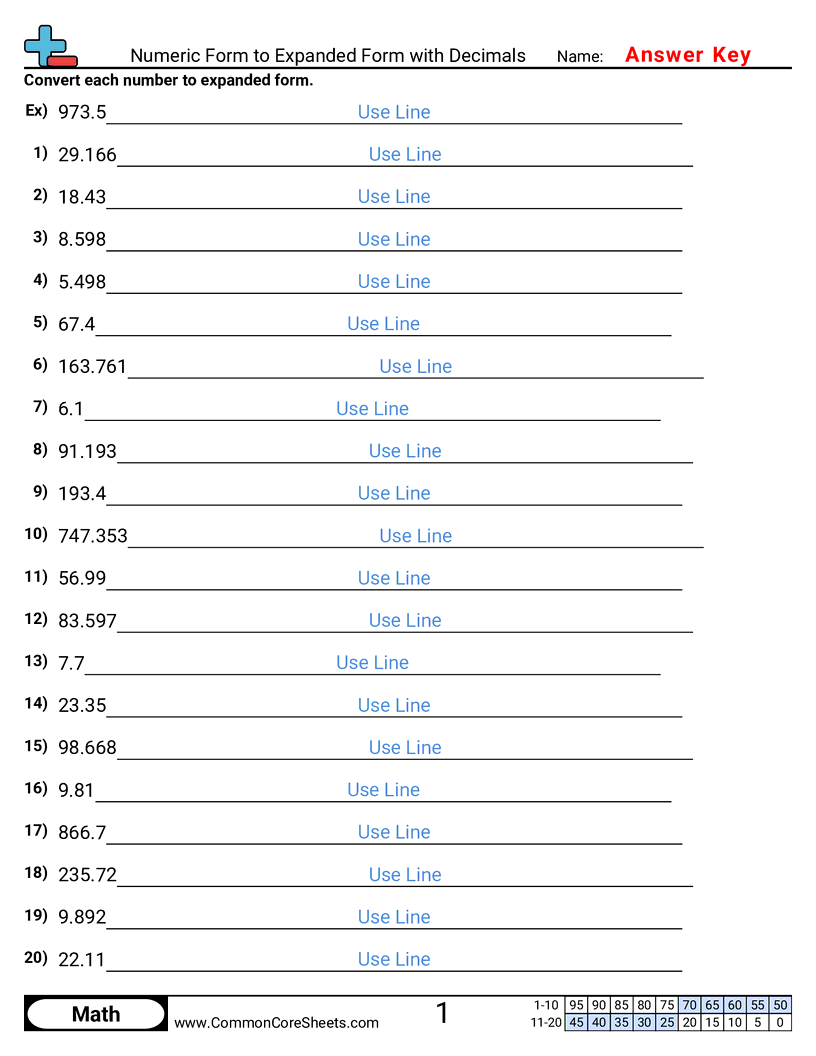
Break a decimal number into the value of each digit using place value. Write a number in expanded form using addition to show how the parts make the whole. Read and interpret digits in tenths, hundredths, and thousandths places. Include zero place values correctly when writing expanded form.
5nbt3a
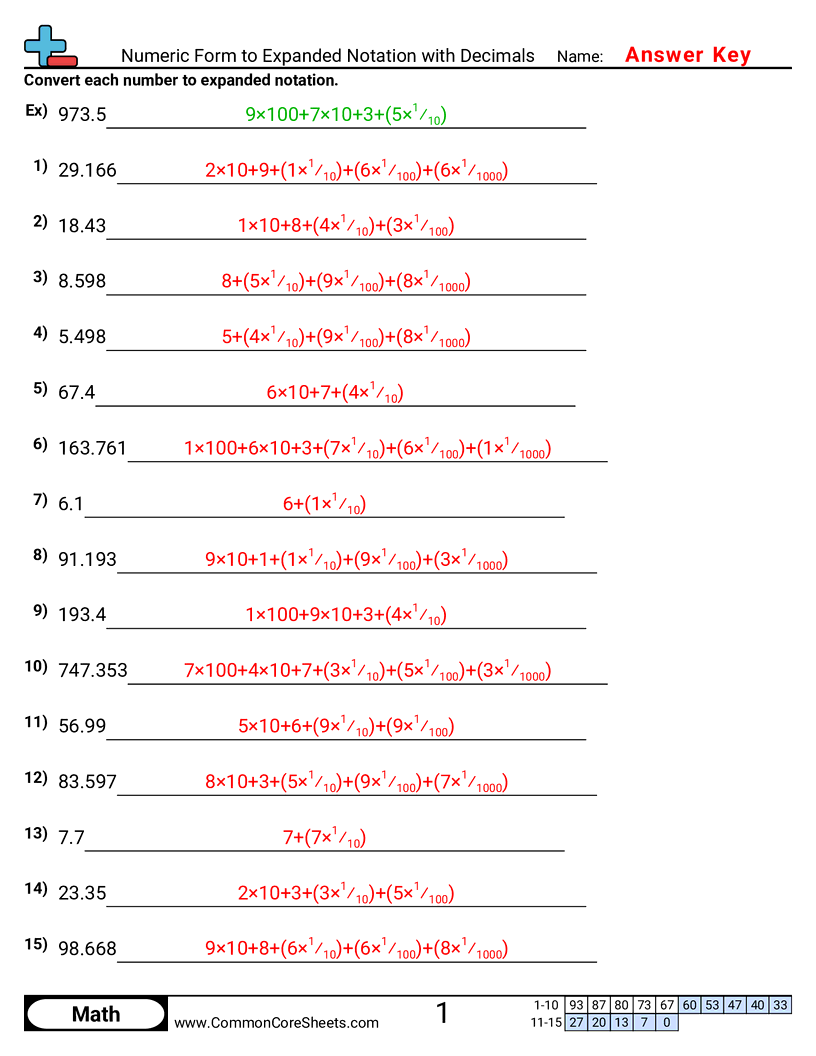
Break a decimal number into the value of each digit and write it as a sum. Match each digit to its correct place value, including tenths, hundredths, and thousandths. Use zeros as placeholders so the expanded notation still shows the correct value. Read a decimal number and explain what each part is worth in expanded form.
4nf6
Read a number written out by its place values and rewrite it as one number Understand what the tenths and hundredths digits mean in a decimal Add up place values like ones, tenths, and hundredths to form a decimal Practice writing decimals correctly with the decimal point in the right spot
4nf6
Read a decimal written out as a sum of place values Write decimals in standard form down to the hundredths place Understand what the tenths and hundredths digits represent Combine whole number and decimal parts into a single number
4nf6
Break a decimal number into the value of each of its digits Show the worth of digits in the tenths and hundredths places Understand that each place is worth ten times less than the one to its left Practice writing decimals as a sum of place values
4nf6
Break a decimal into the value of each digit Write out the tenths and hundredths parts of a number separately Understand what each place after the decimal point is worth Convert a standard decimal number into expanded form
Playwire Advertisement