4nf2×Description:
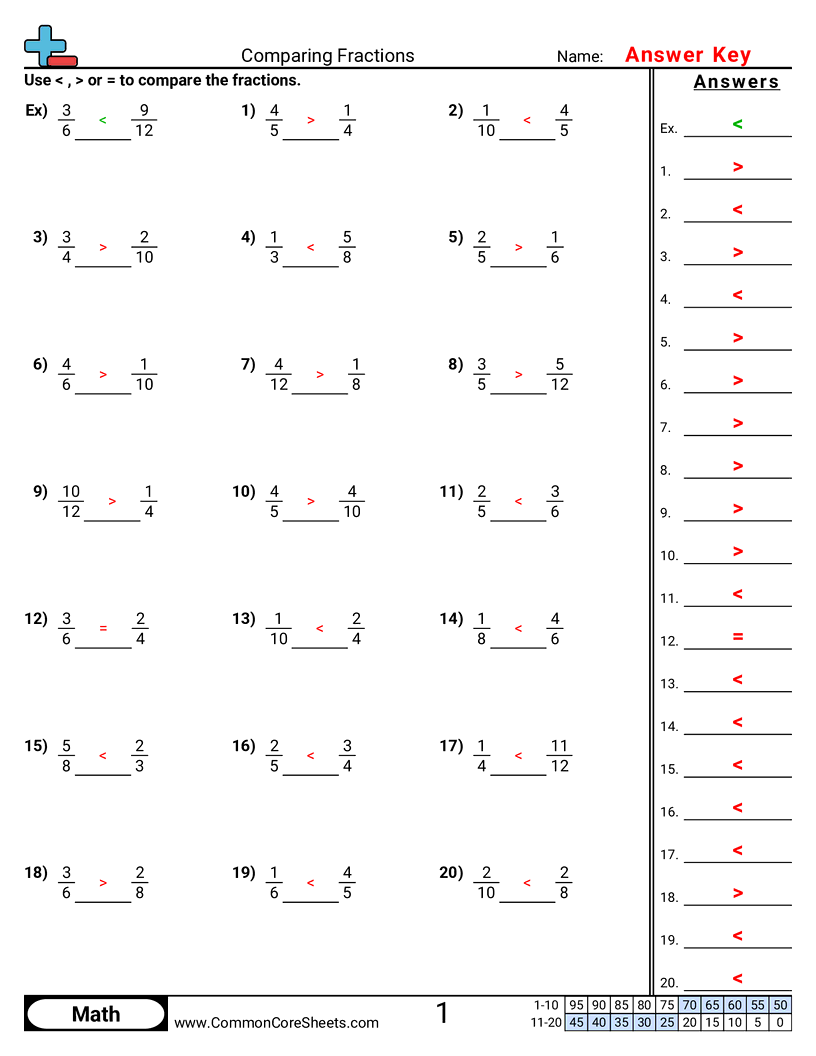
"This worksheet is designed to strengthen children's understanding of comparing fractions in math. It contains 20 distinct problems, where children will decide if one fraction is greater than, less than, or equal to another. Dynamic and engaging, this material can be customized based on learner's needs. It also has the capacity to be converted into flashcards for a more visual approach and is adaptable for distance learning, maximizing instruction during remote education sessions."
×Student Goals: Understanding of FractionsUpon completion of the worksheet, students should have an improved understanding of fractions. They should be able to identify the numerator as the number that represents a part of the whole and the denominator as the total number of parts in that whole. Recognizing these aspects of fractions is fundamental to further mathematical learning.Comparing FractionsStudents should have mastered how to compare fractions effectively. They should be able to determine if a fraction is less than, equal to, or greater than another and justify their reasoning. The comparison of fractions is a fundamental skill that students will utilize in various aspects of their lives, from simple daily activities to complex problem solving in future mathematics studies.Proportional ReasoningThis worksheet should provide students with a clear understanding of proportional reasoning concepts. Through comparing fractions, students should begin to grasp the reciprocal relationship between the numbers in a fraction and the principled way in which they interact. This essential comprehension will assist them in solving more sophisticated mathematical problems down the line.Augmented Problem-Solving AbilitiesBy completing this worksheet, students should significantly improve their problem-solving abilities. They will enhance not only their critical thinking skills but also their ability to apply mathematical principles to solve problems systematically. This improvement will definitely provide a solid foundation for more complex mathematical tasks that they will encounter through their educational journey.Familiarity with Fractional NotationHaving worked with a variety of fractions on this worksheet, students should develop a familiarity with fractional notation. They should understand the differences between proper and improper fractions and be able to recognize equivalent fractions. This understanding of fractional notation will greatly assist them when they progress to additional math subjects such as algebra and calculus.Build ConfidenceCompletion of the worksheet should instill a sense of mathematical confidence in the students. Familiarity and understanding of the topic should reduce math anxiety and encourage students to take on more challenging mathematical concepts. Handling complex problems with ease will boost their confidence and enhance their overall academic performance.