Pelican Worksheet Download
Free reading worksheets on Pelican. Each worksheet has 20 problems with an answer key and are ideal for teachers and homeschooling. You can download the PDF, create a set of flash cards or set it up for online learning.
Select a Different Activity
>


Sheet Information >
Available at 2nd grade, 3rd grade, 4th grade, 5th grade and 6th grade reading levels.
Read the passage
Say hello to the wonderful world of pelicans, kiddos! These cool birds have a large beak that they use to scoop up fish for dinner. Sometimes, they even share their catch with other animals, making them pretty popular at the lunch table.
Now, let's dive into where these friendly birds live and their life cycle. Pelicans can be found all over the world, living near the sea, rivers, and lakes where they can find plenty of fish. They lay eggs and when the babies, called chicks, are born, both mom and dad take turns feeding them.
Finally, let's chat about how pelicans interact with us humans and other animals. While they usually keep to themselves, pelicans are known to be friendly to humans and are often found living peacefully alongside other birds and animals. Isn't it fun to learn about these amazing creatures, who are so different from other bird species?
"Did you know that pelicans are one of the largest flying birds?" They're easy to spot with their long beak and a large throat pouch used for catching prey and draining water before they swallow. Pelicans primarily eat fish, but they're not picky eaters. Sometimes, they also munch on amphibians, turtles, and even crustaceans. Different species of pelicans live in various places, from the tropics to temperate zones, usually near lakes and rivers, and oceans.
"Now let's dive into the life cycle of a pelican." These amazing birds can live up to 25 years in the wild. They reach adulthood at three years old and choose one mate for life. The couple builds a nest where the female lays 2 to 3 eggs, and both parents take turns incubating them. Baby pelicans are born without feathers, but after a month, a soft brown coat grows.
"Pelicans have a unique relationship with other creatures and humans." They often live in harmony with other birds and animals, sharing space and food resources. As for humans, they are generally friendly and not harmful, but sometimes they are hunted for their feathers or because they compete with fishers for food. Did you know that pelicans have no real natural enemies except for humans? They use their strong beak and wings as their main form of defense.
"Finally, let's learn about the differences between the pelican species and some fun facts." There are eight different species of pelicans, and while they all have the famous pouch and are pretty large, they can be different colors, from brown and grey to beautiful pink and white. One fun fact is that a pelican's beak can hold up to three gallons of water! Isn't it fascinating to learn about these incredible birds? I hope you enjoyed learning about pelicans as much as I did sharing about them."
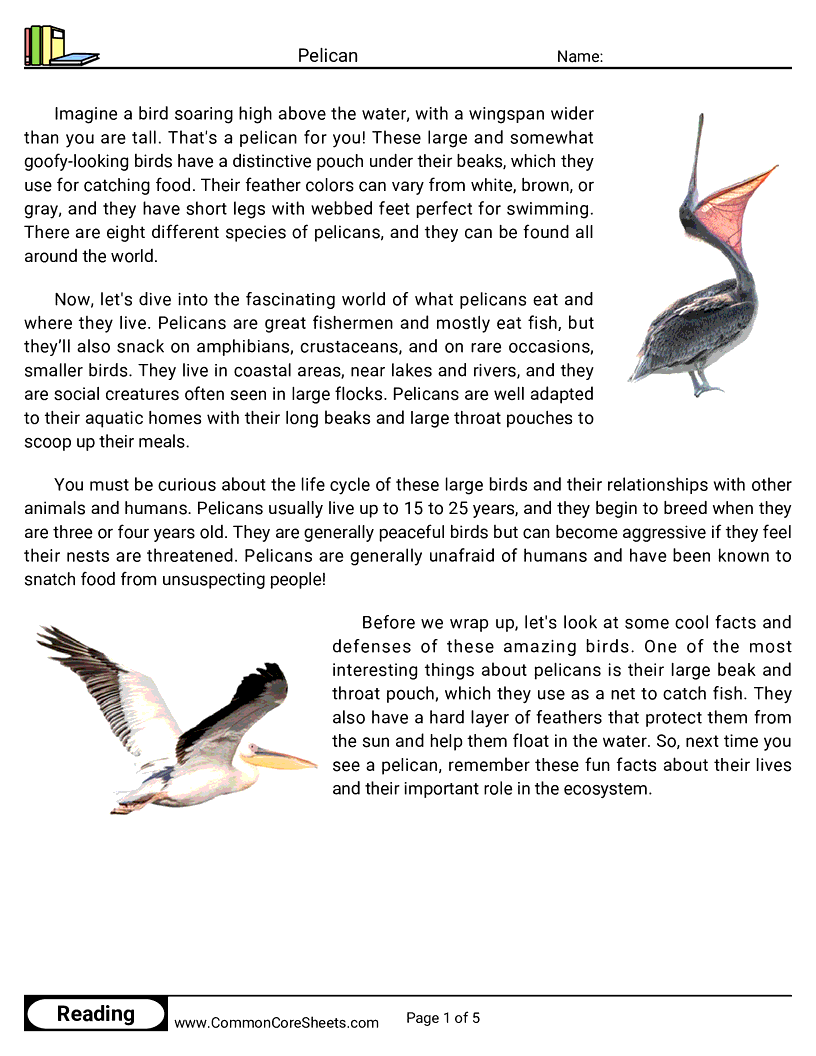
Imagine a bird soaring high above the water, with a wingspan wider than you are tall. That's a pelican for you! These large and somewhat goofy-looking birds have a distinctive pouch under their beaks, which they use for catching food. Their feather colors can vary from white, brown, or gray, and they have short legs with webbed feet perfect for swimming. There are eight different species of pelicans, and they can be found all around the world.
Now, let's dive into the fascinating world of what pelicans eat and where they live. Pelicans are great fishermen and mostly eat fish, but they’ll also snack on amphibians, crustaceans, and on rare occasions, smaller birds. They live in coastal areas, near lakes and rivers, and they are social creatures often seen in large flocks. Pelicans are well adapted to their aquatic homes with their long beaks and large throat pouches to scoop up their meals.
You must be curious about the life cycle of these large birds and their relationships with other animals and humans. Pelicans usually live up to 15 to 25 years, and they begin to breed when they are three or four years old. They are generally peaceful birds but can become aggressive if they feel their nests are threatened. Pelicans are generally unafraid of humans and have been known to snatch food from unsuspecting people!
Before we wrap up, let's look at some cool facts and defenses of these amazing birds. One of the most interesting things about pelicans is their large beak and throat pouch, which they use as a net to catch fish. They also have a hard layer of feathers that protect them from the sun and help them float in the water. So, next time you see a pelican, remember these fun facts about their lives and their important role in the ecosystem.
Let's talk about pelicans, these amazing birds that can be seen flying over the sea or resting on a light pole! They are known for their long beak and large throat pouch which they use for catching prey and draining water from the scooped-up contents before swallowing. Pelicans are quite large, with most species measuring between 1.3 to 1.8 meters (4.3 to 5.9 feet) in length, and they're mainly white, grey or brown. There are eight species of pelican in the world, all of which are similar but have some differences like their size and the place where they live.
Now let's dive into their diet and how they feast! Pelicans love water, and their main source of food comes from the sea, they eat fish, but they also eat amphibians, turtles, crustaceans, and occasionally birds. They plunge from the air to catch their prey in their beak, or simply float on the water and scoop up fish in their large pouches. Unlike other birds, pelicans do not store fish in their pouch, but simply use it to catch their food and then swallow.
Pelicans are quite sociable and live in flocks of both small and large sizes. They breed in colonies and build stick nests in trees, shrubs or on the ground, and the female usually lays 2 or 3 eggs. The baby pelicans, called chicks, stay in their nest for about three months until they learn to fly. Pelicans live on every continent except Antarctica, they can be found along coastal areas, estuaries, and lakes, and some species are even capable of living in the inhospitable desert environments!
Now, you might be wondering how pelicans defend themselves. When threatened, pelicans have been known to spit at or bite the intruder with their large and powerful beaks. They also fly away from danger with their strong wings, and their large size is often enough to deter potential predators. Pelicans also have few natural enemies but must watch out for eagles who will try to steal their food and occasionally their young!
Finally, let's talk about pelicans and us. Pelicans are often friendly and unafraid of humans, probably because humans do not pose a significant threat to them. However, they can be a nuisance to fisheries because they consume large amounts of fish, but generally, they are considered beneficial because they eat fish that are considered pests. So next time when you see a pelican, remember they are a part of this beautiful ecosystem and play a very important role.
Hey there, have you ever wondered about pelicans, those peculiar birds you often see in cartoons? Pelicans are large water birds that belong to the family Pelecanidae. They are easily recognizable due to their large body, long beak and a large throat pouch used for catching prey. Pelicans can be found all over the world, living in areas near oceans, rivers and lakes. There are eight different species of pelicans, each with their own unique characteristics and habitats.
Now, let's dive into the diet of these fascinating creatures. Pelicans are primarily fish eaters, but they also munch on amphibians, crustaceans, and other small animals when they get the chance. They use their distinctive pouch-like beaks to scoop up their prey from the water, often while flying or swimming. Interestingly, they don't store their food in their pouch, but simply use it as a net to capture their meal before swallowing it whole. This unique way of feeding is one of the things that sets pelicans apart from other bird species.
Let's talk about the life cycle of a pelican. Pelicans begin their life in a nest, and are taken care of by their parents until they are old enough to venture out on their own. They reach adulthood at 3 to 4 years of age, and can live up to 15 to 25 years in the wild. During breeding season, pelicans often gather in large colonies, providing protection and abundant food resources for their young. Mating for life is common for pelicans, which is pretty cool, don't you think?
Pelicans have a unique relationship with humans and other animals. In some cultures, pelicans are considered symbols of love and sacrifice, while in others, they are seen as bringers of luck or prosperity. Despite their large size, pelicans are not typically a threat to humans or other animals, unless they feel their nest is threatened. As for their defense, pelicans rely on their large size, loud vocalizations, and sometimes their beaks to ward off potential threats. Unfortunately, pelicans often face threats from human activities, including habitat loss and pollution, which can impact their survival.
Now for some interesting facts about pelicans that you might not know. Did you know that a pelican's beak can hold up to three gallons of water? Or that they can fly up to 30 miles per hour and can travel over 90 miles to find a feeding site? In ancient Egypt, pelicans were considered sacred and were often depicted in their art and mythology. Pelicans are truly marvelous creatures, don't you agree?
About this worksheet
Students read a short informational passage about pelicans and answer comprehension questions about the bird's traits and habits.
This worksheet is designed to enhance children's understanding of pelicans, covering key aspects like their habitat, diet, lifespan, and characteristics through 20 interactive reading problems. The worksheet can be customized to individual learning preferences, converted into flashcards, or integrated into distance learning programs for a versatile and engaging educational resource.
Student objectives
- Read an informational passage about pelicans and understand the main idea
- Recall facts about how pelicans look, eat, and live
- Answer questions using details found in the text
- Learn new vocabulary related to birds and nature
Everyday practice
- Read a sign at the zoo or aquarium describing a pelican and understand it
- Talk about birds you see near the beach or a lake
- Look up facts about an animal you're curious about and explain them to someone
- Point out a pelican and describe what it eats when visiting the coast