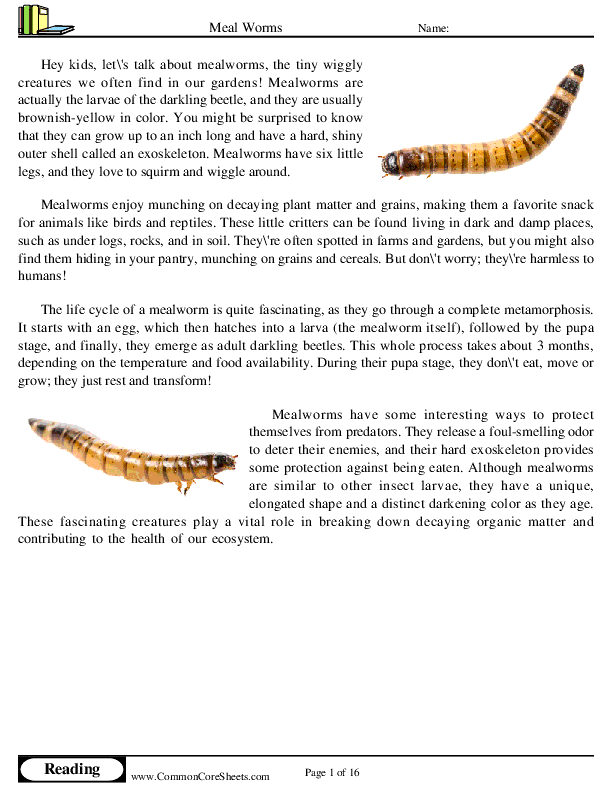
Meal Worms Worksheet Download
Free reading worksheets on Meal Worms. Each worksheet has 20 problems with an answer key and are ideal for teachers and homeschooling. You can download the PDF, create a set of flash cards or set it up for online learning.
Select a Different Activity
>
Sheet Information >
Available at 2nd grade, 3rd grade, 4th grade, 5th grade and 6th grade reading levels.
Read the passage
Let\'s learn about mealworms, which are fascinating little critters! They are actually not worms at all, but the larval stage of the darkling beetle. These little guys are typically a golden-brown color and have a tough exoskeleton to protect themselves.
Mealworms have an interesting life cycle that begins as an egg. From the egg, they hatch into larva (that\'s the mealworm!), then they become a pupa, and finally, they transform into adult beetles. They eat a variety of things, such as grains, fruits, and vegetables, making them easy to find in places like your pantry.
Did you know that mealworms have a unique relationship with humans and other insects? Some people use mealworms as a sustainable food source for animals and even for themselves. In the wild, they help break down dead plants and animals, making them an important part of the ecosystem. Now you know a little more about these fascinating creatures and the role they play in our world!
Let\'s talk about mealworms, tiny creatures that are super interesting to learn about! These little insects are actually the larvae of the darkling beetle and have a yellowish-brown color. They love to eat fresh or decaying plant matter, like fruits, vegetables, and grains. You can find them living in dark, damp places like under logs, rocks, or in stored grains.
Now, let\'s explore the life cycle of a mealworm, which is quite a fascinating journey. It starts as an egg, then hatches into a larva (the mealworm), grows into a pupa, and finally becomes an adult darkling beetle. Throughout their life, mealworms molt, or shed their skin, many times as they grow. This entire process, from egg to beetle, takes about 90 days to complete.
Mealworms have some pretty cool relationships with humans and other insects. While they can be considered pests if they get into our stored grains, they are also an important food source for birds, reptiles, and other animals. Their defenses include releasing a bad smell to ward off predators, and their hard exoskeleton helps protect them from harm. One interesting fact about mealworms is that they are being researched as a sustainable protein source for humans and animals, as they require less resources to grow compared to other protein sources. Mealworms are fascinating little creatures that play an important role in the ecosystem. They may be small, but their life cycle and relationships with other living things make them a truly amazing insect to learn about. Who knew such a tiny creature could be so interesting?
Get ready to wiggle into the world of the mealworm! These little creatures are more than just an average bug. They are small, yellow-brown worms that are about one to two inches long. You might think they are slimy like other worms, but they're not! They have a hard outer shell, called an exoskeleton. And guess what? They're not even really worms, but the larval stage of the Darkling Beetle.
Speaking of the Darkling Beetle, let's learn about the life cycle of these tiny wrigglers. It all starts when a female beetle lays hundreds of tiny, white eggs. After just a few days, the eggs hatch into tiny mealworms, which spend their time eating and growing until they're ready to turn into pupae. After a couple of weeks, the pupae transform into adult Darkling Beetles, and the cycle starts all over again!
Now that we know how they grow, let's dive into where you might find these critters and what they munch on. Mealworms are found all over the world and they love to live in dark, damp places like under logs or in your pet's food dish. Their favorite foods are grains, vegetables, and other decaying matter. But don't worry, they're not pests. In fact, they help break down dead plants and animals in the environment.
These little wiggly wonders aren’t just interesting for their life cycle and diet, they also have a special relationship with humans and other animals. For humans, they're often used as food for pets like birds, fish, and reptiles, and some scientists are even studying them as a source of food for people! For other animals, they are a tasty snack and a crucial part of the food chain. So, the next time you see a mealworm, remember that they're much more than just a little worm – they're an important part of our world!
Have you ever wondered about the fascinating world of mealworms? Mealworms are the larval stage of the darkling beetle and are commonly found in temperate regions. They might look a little strange, but these little critters play an important role in our ecosystem. Let\'s dive into the life of mealworms and learn more about their habits, characteristics, and interesting facts.
Firstly, let\'s talk about what mealworms eat. As their name suggests, mealworms love to munch on grains and cereals, as well as fruits and vegetables. Interestingly, they can even eat decaying matter, making them nature\'s little recyclers! In the wild, mealworms play a crucial role in breaking down organic matter and returning nutrients to the soil.
Now, let\'s explore the life cycle of a mealworm. Mealworms go through four stages of development: egg, larva, pupa, and adult beetle. It takes about three months for a mealworm to go from egg to adult, and during that time, they shed their exoskeleton multiple times as they grow. Once they reach adulthood, the darkling beetle lays eggs, starting the cycle over again.
How do mealworms relate to humans and other insects? Mealworms are a popular choice as food for pets like reptiles, birds, and fish due to their high protein content. Humans have even started exploring the use of mealworms as a sustainable protein source for themselves! In the insect world, mealworms serve as a food source for other insects, birds, and small mammals.
Lastly, let\'s look at some interesting facts and differences between mealworms and other species. Unlike some other insects, mealworms do not have any special defense mechanisms, relying on their tough exoskeleton and hiding in dark places for protection. While they might look similar, mealworms are different from other worm species like earthworms, as they are actually the larvae of beetles. Did you know that some mealworms can even eat plastic, potentially helping with our global waste problem? In conclusion, mealworms are fascinating creatures with a unique life cycle, diet, and relationship to humans and other insects. Learning about mealworms helps us appreciate their importance in our ecosystem and the potential benefits they can offer.
Hey there, curious minds! Let\'s talk about mealworms, those little wiggly creatures that might seem a bit strange at first. Mealworms are actually the larval stage of the darkling beetle, and they\'re called mealworms because of their love for grains and cereals. These little guys are yellowish-brown in color, have a hard exoskeleton, and can grow up to an inch in length. You might find mealworms in places like pet stores, where they\'re sold as food for reptiles and birds. But don\'t worry, they\'re not harmful to humans!
Now, let\'s dive into the fascinating life cycle of mealworms. Their life begins as a tiny egg, which hatches into the mealworm larva after just a few weeks. This stage lasts several months, during which time the mealworm will eat and grow, shedding its skin multiple times. When it\'s ready, the mealworm will enter the pupa stage, where it looks like a little brown alien and doesn\'t eat at all. Finally, after a few weeks, the adult darkling beetle emerges, ready to lay eggs and start the cycle all over again.
You might be wondering how mealworms interact with humans and other insects. Well, as mentioned earlier, mealworms can be a valuable food source for pet reptiles, birds, and even some fish. They\'re also being studied as a potential sustainable food source for humans, as they\'re high in protein and can be raised with minimal environmental impact. In the wild, mealworms are known to eat decaying plant matter and grains, which helps break down organic material. This makes them helpful decomposers in the ecosystem, although they can become pests if they get into stored food.
So how do mealworms defend themselves from predators? Their hard exoskeleton provides some protection, making it difficult for smaller predators to eat them. Additionally, mealworms are quite good at hiding in dark, small spaces, which helps them avoid being spotted by hungry animals. Their brownish-yellow color also helps them blend into their surroundings, acting as a natural camouflage. Finally, when they become adult beetles, they have the ability to release a foul-smelling odor to deter predators.
Before we wrap up, let\'s explore some differences between mealworms and other insect species. While mealworms may look similar to other worm-like larvae, they\'re actually quite different from earthworms, which are not insects at all. Earthworms are annelids, a completely different group of animals, and they don\'t have an exoskeleton or go through the same life cycle as mealworms. Similarly, mealworms are distinct from maggots, which are the larval stage of flies and have a soft, almost transparent body. So, as you can see, mealworms are unique little creatures with their own special characteristics. And there you have it, a fascinating look into the world of mealworms! We hope you enjoyed learning about these intriguing little insects and their importance in our world. Keep exploring, and you\'ll never cease to be amazed by the wonders of nature.
About this worksheet
Students read a short passage about meal worms and answer questions to show they understood the key details and facts.
This worksheet is designed to educate children on the life and characteristics of mealworms through reading comprehension. A versatile resource, it offers 20 multiple-choice questions about mealworm habitats, physiology, and their significant role in the environment. The worksheet promotes active learning, suitable for distance study, and can easily be customized into flashcards or other engaging formats to cater to various learning styles.
Student objectives
- Read a nonfiction passage and understand what it is about
- Find and recall specific facts stated in the text
- Answer questions using details from what you read
- Learn new information about meal worms and how they live
Everyday practice
- Read the care instructions on a pet food or bait container
- Understand facts about animals when reading a nature book or article
- Answer someone's questions about something you just read
- Explain what you learned from a passage to a friend or parent