Mallard Worksheet Download
Free reading worksheets on Mallard. Each worksheet has 20 problems with an answer key and are ideal for teachers and homeschooling. You can download the PDF, create a set of flash cards or set it up for online learning.
Select a Different Activity
>
Sheet Information >
Available at 2nd grade, 3rd grade, 4th grade, 5th grade and 6th grade reading levels.
Read the passage
Meet the Mallard, a type of duck that's as fascinating as it is colorful. Mallards are easily recognizable with their bright green heads, yellow bills, and brown chests. These ducks live all over the world in both fresh and saltwater areas, making them one of the most widespread types of ducks.
Let's talk about what Mallards eat and their life cycle. Mallards are not picky eaters and will munch on plants, seeds, and even small creatures like insects and snails. As for their life cycle, they start as eggs in a nest, then grow into ducklings before becoming full-grown ducks.
Mallards have an interesting relationship with humans and other animals. They're often seen in parks and lakes, where people enjoy feeding them, and they get along well with other waterfowl, but have defenses like their beak and wings to protect themselves if needed. In closing, Mallards are not just common ducks, they're a special part of nature with unique characteristics and a rich life cycle.
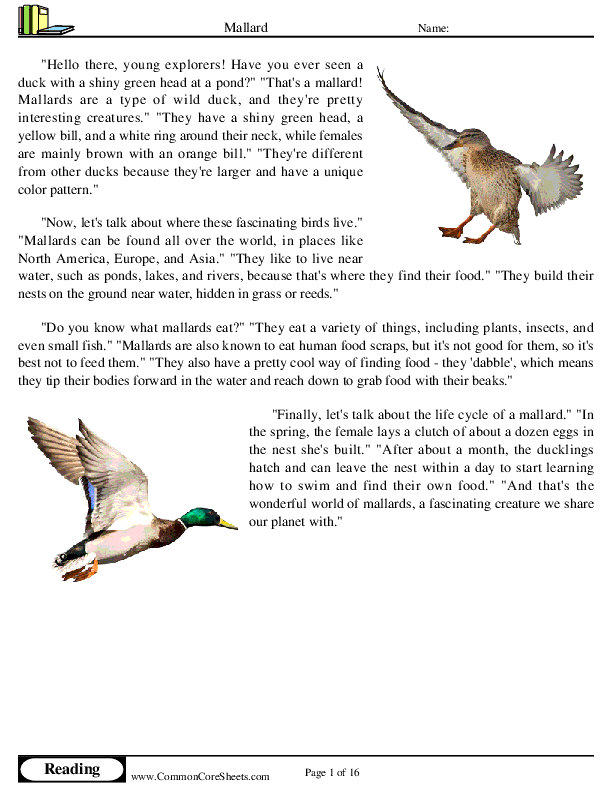
Say hello to the marvellous mallards, the most familiar ducks we see around! These ducks are easy to spot with the males having a shiny green head, while the females are mostly brown. Unlike some other duck species, mallards can live in almost any wetland habitat, be it a pond, river, or marsh. They adapt to human-made habitats as well, so it's not uncommon to see them in city parks or farm fields.
Now, let's talk about what these mallards munch on and their life cycle. Mallards eat a variety of food like seeds, acorns, berries, insects, and even small fish. When it comes to their life cycle, they typically mate and nest in the spring. After the mom lays the eggs, she takes care of them until they hatch in about a month. These cute little ducklings can swim and find their own food just a few hours after hatching, isn't that amazing?
Mallards have a special relationship with humans and other animals. People often feed them in parks, but it's healthier for them to find their own natural food. They share their habitats with other animals, living peacefully with most, but they have to watch out for foxes and raccoons who might try to eat their eggs. When they sense danger, they use their strong wings to fly away quickly. Did you know that the mallard is the ancestor of nearly all domestic duck breeds? That's one cool fact about our feathery friends!
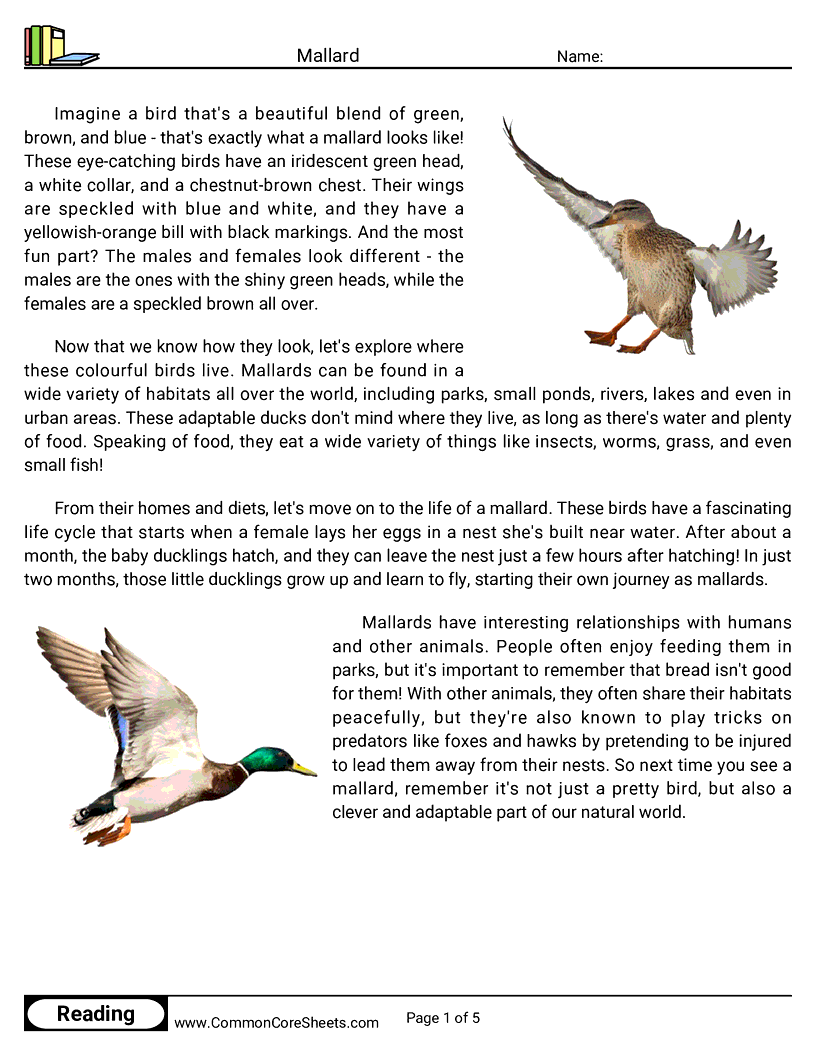
Imagine a bird that's a beautiful blend of green, brown, and blue - that's exactly what a mallard looks like! These eye-catching birds have an iridescent green head, a white collar, and a chestnut-brown chest. Their wings are speckled with blue and white, and they have a yellowish-orange bill with black markings. And the most fun part? The males and females look different - the males are the ones with the shiny green heads, while the females are a speckled brown all over.
Now that we know how they look, let's explore where these colourful birds live. Mallards can be found in a wide variety of habitats all over the world, including parks, small ponds, rivers, lakes and even in urban areas. These adaptable ducks don't mind where they live, as long as there's water and plenty of food. Speaking of food, they eat a wide variety of things like insects, worms, grass, and even small fish!
From their homes and diets, let's move on to the life of a mallard. These birds have a fascinating life cycle that starts when a female lays her eggs in a nest she's built near water. After about a month, the baby ducklings hatch, and they can leave the nest just a few hours after hatching! In just two months, those little ducklings grow up and learn to fly, starting their own journey as mallards.
Mallards have interesting relationships with humans and other animals. People often enjoy feeding them in parks, but it's important to remember that bread isn't good for them! With other animals, they often share their habitats peacefully, but they're also known to play tricks on predators like foxes and hawks by pretending to be injured to lead them away from their nests. So next time you see a mallard, remember it's not just a pretty bird, but also a clever and adaptable part of our natural world.
"Hey there, have you ever seen a cute, green-headed duck at your local park?" That's probably a mallard, one of the most common ducks that you can find around the world. These adorable creatures have a shiny green head, a white collar, and a yellow bill if they're males, while females are mottled brown with an orange bill. Mallards are known for their loud quacking, which is actually the sound made by the females!
"Now, let's talk about where mallards live and what they eat." They are found almost everywhere in North America, Europe, Asia, and even in some parts of Africa. Mallards love to live in wetlands, like marshes and ponds, but you can also find them in city parks and even in your backyard. For their meals, they eat a lot of different things, like insects, worms, grass, and even small fishes.
"Mallards have a quite interesting life cycle." The female lays a clutch of about 8-13 eggs in a nest, which she will then incubate for about a month. The cute little ducklings are then taken care of by their mom, learning to swim and find food until they are old enough to fly and be independent. This process takes around 50-60 days.
"Let's move onto their relationship with humans and other animals." Mallards are generally friendly and get along well with humans, especially if we feed them! However, they also have predators like foxes, raccoons, and large birds of prey. To protect themselves, mallards will try to fly away, hide in the water, or even play dead.
"Finally, let's see what makes mallards different from other species and learn some fun facts." Unlike most other ducks, mallards can live in both fresh and saltwater. An interesting fact is that mallards are 'dabbling ducks' - they feed in the water by tipping forward and grazing on underwater plants. And did you know, mallards are the ancestors of almost all domestic duck breeds? Now that's something to quack about!
Let's dive into the world of mallards, a fascinating type of duck that you've probably seen before! Mallards are easy to identify with their bright green heads, yellow bills, and grey bodies for males, while females sport a more muted brown palette. They are found all over the world, in places like North America, Europe, and even parts of Asia. These ducks are known to live in wetlands, where they can easily find food and shelter. Next time when you see a duck in a park or near a pond, it just might be a mallard!
Now let's talk about what mallards eat, which is quite varied and interesting. They love to eat plants, seeds, and grains, but they also dine on insects, worms, and even small fish. Mallards are known for their 'dabbling' behavior where they dip their heads underwater to find food, while their cute duck-tails bob in the air. This diet makes them omnivores, which means they eat both plants and meat. Mallards have a pretty balanced diet, don't they?
Let's move on to the life cycle of mallards, which is quite fascinating. After mating, the female lays about 8 to 13 eggs in a nest, which she builds in a quiet, hidden spot. The mother duck then incubates the eggs for about a month, protecting them from predators and keeping them warm. Once the ducklings hatch, they leave the nest within a day and can swim and find their own food right away. They grow quickly and in about two months, they look like adult mallards.
Mallards have a special relationship with humans and other animals. Humans often feed mallards in parks, which can actually be harmful if they give them bread or other processed foods. In the wild, mallards interact with other animals like turtles, frogs, and even larger birds like herons. They have few natural predators, but foxes, raccoons, and large birds of prey can pose a threat to their eggs and ducklings. Mallards are pretty sociable creatures, aren't they?
Finally, let's look at some fascinating facts and differences between mallards and other ducks. Unlike many other ducks, mallards can live in both fresh and saltwater. Mallards can also fly up to 55 miles per hour, faster than many other duck species! Another fun fact is that mallards are the ancestors of almost all the domestic duck breeds we have today. So, aren't mallards interesting and unique in their own way?
About this worksheet
Students read a short informational passage about mallard ducks and answer comprehension questions about the facts they learned.
This worksheet is designed to enhance children's reading comprehension skills, focusing on the topic of Mallards. It prompts learning via 20 multiple-choice questions that cover varied aspects, such as color patterns, habitats, and life cycles. Suitable for distance learning, the worksheet content can be customized according to learning needs and easily converted into interactive flashcards for a more engaging educational experience.
Student objectives
- Read a nonfiction passage about mallard ducks
- Find and recall key facts from what you read
- Answer questions using details from the text
- Learn new vocabulary related to ducks and their habitats
Everyday practice
- Read a fact sheet at a pond or park about local ducks
- Look up information about an animal you spotted outside
- Share facts you learned about ducks with family members
- Understand a wildlife description in a nature magazine or book