Honey Bees Worksheet Download
Free reading worksheets on Honey Bees. Each worksheet has 20 problems with an answer key and are ideal for teachers and homeschooling. You can download the PDF, create a set of flash cards or set it up for online learning.
Select a Different Activity
>


Sheet Information >
Available at 2nd grade, 3rd grade, 4th grade, 5th grade and 6th grade reading levels.
Read the passage
Did you know honey bees are amazing creatures? They are small, fuzzy insects that have six legs and two pairs of wings. Their bodies are black and yellow, and they love to buzz around flowers collecting nectar and pollen to eat.
Honey bees live in large groups called colonies, where they all work together to build their home called a hive. There are three types of bees in a colony: the queen, the workers, and the drones. The queen lays eggs, the workers take care of the hive and collect food, and the drones mate with the queen to create more bees.
We humans have a special relationship with honey bees because they help our plants grow by pollinating them. Bees also make honey, which we can eat and use as a natural sweetener. Bees have a great defense system called a stinger to protect themselves against other insects and threats, but remember, it\'s important to protect these amazing creatures and treat them with kindness.
Honey bees are amazing little creatures that play a very important role in our world. These tiny insects live in colonies that can have up to 60,000 bees, and they work together to collect nectar from flowers. When they return to their hive, they turn the nectar into honey, which they use as food. Honey bees also help to pollinate flowers, which helps plants to grow and produce the fruit and vegetables that humans and other animals eat.
The life cycle of a honey bee is pretty interesting, and it has four stages - egg, larva, pupa, and adult. The queen bee lays thousands of eggs, which then hatch into larvae after about 3 days. These larvae grow and transform into pupae, and after about 12 days, they become adult bees ready to work and help their colony. The adult bees have different roles, such as worker bees, drone bees, and the queen bee, who is the only bee that can lay eggs.
Honey bees are generally friendly insects, but they have some ways to protect themselves and their colony. Their main defense is their stinger, which they use to sting other insects or animals that may be a threat. However, unlike some other bee species, honey bees can only sting once, and then they die. It\'s important to remember that honey bees are very important for our environment, so we should always be kind to them and let them do their amazing work.
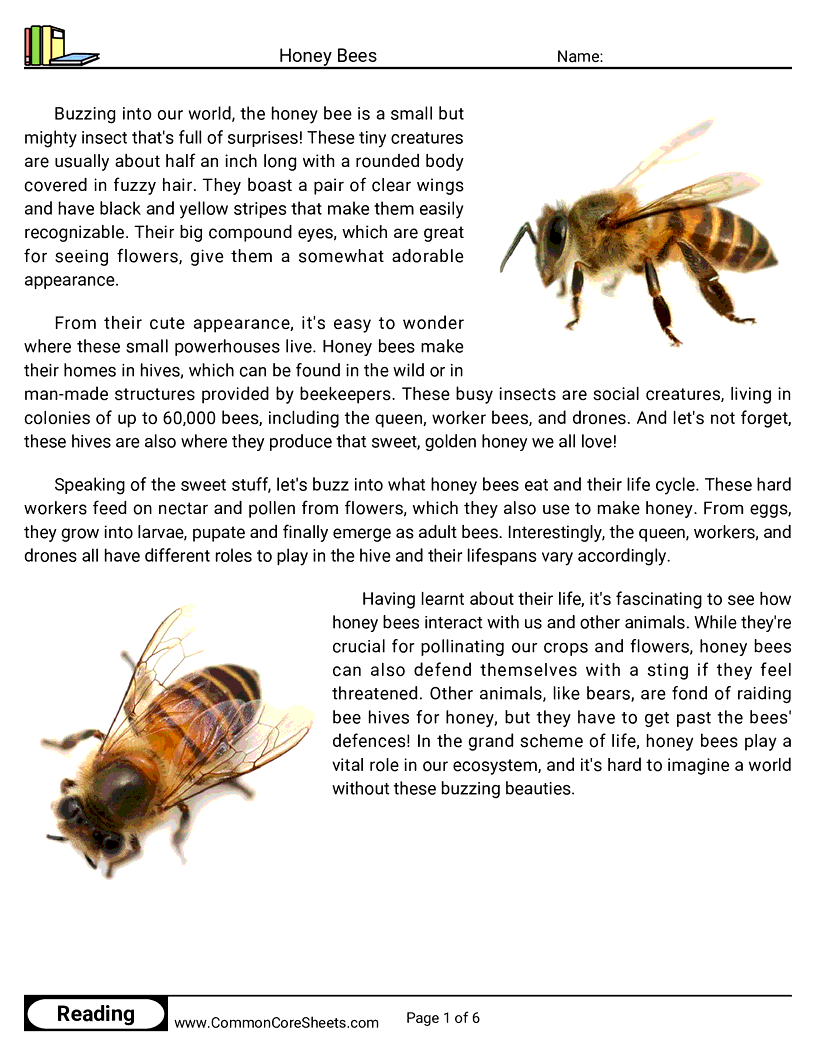
Buzzing into our world, the honey bee is a small but mighty insect that's full of surprises! These tiny creatures are usually about half an inch long with a rounded body covered in fuzzy hair. They boast a pair of clear wings and have black and yellow stripes that make them easily recognizable. Their big compound eyes, which are great for seeing flowers, give them a somewhat adorable appearance.
From their cute appearance, it's easy to wonder where these small powerhouses live. Honey bees make their homes in hives, which can be found in the wild or in man-made structures provided by beekeepers. These busy insects are social creatures, living in colonies of up to 60,000 bees, including the queen, worker bees, and drones. And let's not forget, these hives are also where they produce that sweet, golden honey we all love!
Speaking of the sweet stuff, let's buzz into what honey bees eat and their life cycle. These hard workers feed on nectar and pollen from flowers, which they also use to make honey. From eggs, they grow into larvae, pupate and finally emerge as adult bees. Interestingly, the queen, workers, and drones all have different roles to play in the hive and their lifespans vary accordingly.
Having learnt about their life, it's fascinating to see how honey bees interact with us and other animals. While they're crucial for pollinating our crops and flowers, honey bees can also defend themselves with a sting if they feel threatened. Other animals, like bears, are fond of raiding bee hives for honey, but they have to get past the bees' defences! In the grand scheme of life, honey bees play a vital role in our ecosystem, and it's hard to imagine a world without these buzzing beauties.
Have you ever wondered about the fascinating world of honey bees? These little insects are not only important for making honey, but they also play a huge role in pollinating plants. There are over 20,000 different species of bees, but honey bees are unique because they live in large colonies and produce honey. Let\'s dive into the world of honey bees and learn more about their lives!
First, let\'s explore what honey bees eat and where they live. Honey bees mostly feed on nectar and pollen from flowers, which provide them with the energy and nutrients they need to survive. They live in large colonies called hives, which are usually found in trees or man-made structures. Each hive has one queen bee, thousands of worker bees, and a few hundred male bees called drones.
Now, let\'s talk about the honey bee\'s life cycle. It all starts when the queen bee lays eggs, which hatch into larvae after a few days. The larvae are then fed and cared for by worker bees until they grow into pupae. Finally, after about three weeks, the pupae transform into adult honey bees and start their life in the colony.
Honey bees have a special relationship with humans and other insects. Humans have been keeping bees for thousands of years to collect honey and beeswax, and for pollination of crops. Honey bees also help other insects by pollinating flowers, which allows the plants to produce seeds and fruits. In turn, this provides food for other animals and helps maintain a healthy ecosystem.
Lastly, let\'s discuss the honey bee\'s defenses and some interesting facts. Honey bees have a stinger to defend themselves, but they can only sting once because their stinger gets stuck in their victim and they die. An interesting fact is that honey bees are the only species of bee that dies after stinging. Another cool thing about honey bees is that they communicate with each other through special dances, which tell their fellow bees where to find food. Now that you\'ve learned more about these amazing insects, you can truly appreciate the important role they play in our world!
Honey bees are truly fascinating creatures that play an important role in our world. These small insects are known for their hard work and ability to produce delicious honey. Honey bees are social insects that live in large colonies called hives, often containing thousands of bees. The colony consists of three types of bees: the queen, worker bees, and drones. Each type of bee has a specific role to play in the hive\'s daily life.
Let\'s take a closer look at what honey bees eat. Their primary food source is nectar, a sweet liquid found in flowers. Honey bees also collect pollen, which provides them with essential nutrients and proteins. They store this collected nectar and pollen in the hive, where it is used to feed the entire colony. The nectar is also turned into honey by worker bees, which serves as a long-lasting food source.
The life cycle of honey bees is a fascinating process. It all begins with the queen bee laying eggs in the hive\'s cells. These eggs hatch into larvae, which are fed by worker bees and eventually develop into pupae. The pupae then transform into adult bees, emerging from their cells to join the colony. The entire process takes about three weeks from egg-laying to adulthood.
Honey bees have a unique relationship with both humans and other insects. Humans have been keeping bees for thousands of years, primarily for their honey and beeswax. Bees also play a crucial role in pollination, helping plants to produce fruits and seeds. In turn, this benefits other insects and animals that rely on those plants for food and shelter. Honey bees have a few natural predators, such as birds, spiders, and other insects, but they are able to defend themselves with their stingers.
Finally, let\'s explore some interesting facts and differences between honey bees and other species. Honey bees are just one of over 20,000 different species of bees in the world. Unlike some other bee species, honey bees can communicate with each other using a special dance called the 'waggle dance' to share information about food sources. Honey bees can fly up to 15 miles per hour and can visit up to 100 flowers in a single trip. These amazing insects can even recognize human faces, which is a skill that not many insects possess.
About this worksheet
Students read a passage about honey bees and answer questions to show they understood the key facts and details.
This worksheet is designed to enlighten children on the fascinating world of honey bees. Through 20 interactive reading problems, it engages learners in understanding the anatomy, behavior and lifestyle of these essential pollinators. This versatile material can be customized, converted into flashcards or utilized in distance learning, ideally suited to cater to different teaching strategies and learning styles.
Student objectives
- Read a nonfiction passage about honey bees
- Find and recall facts stated in the reading
- Answer questions using details from the text
- Understand new words and ideas about how bees live and work
Everyday practice
- Read a sign about bees at a park or garden and explain what it says
- Talk about why bees are important when you see them near flowers
- Look up facts about an animal for a school project and remember the main points
- Explain to a friend how honey is made after reading about it