Giant Long-Legged Katydid Worksheet Download
Free reading worksheets on Giant Long-Legged Katydid. Each worksheet has 20 problems with an answer key and are ideal for teachers and homeschooling. You can download the PDF, create a set of flash cards or set it up for online learning.
Select a Different Activity
>


Sheet Information >
Available at 2nd grade, 3rd grade, 4th grade, 5th grade and 6th grade reading levels.
Read the passage
Have you ever heard of the Giant Long-Legged Katydid? This amazing insect is known for its incredibly long legs and vibrant green color. They live in the rainforests of Malaysia and Borneo and have many fascinating traits.
The Giant Long-Legged Katydid has a pretty interesting diet. They love to munch on leaves, flowers, and even other insects! Their life cycle is also quite unique, as they go through a process called incomplete metamorphosis where they hatch from eggs, grow as nymphs, and then become adults.
Now, let\'s talk about their relationship with humans and other insects. These insects are not harmful to humans, but their loud, musical chirping can be heard at night in the rainforest. Their long legs help them defend themselves against predators and their bright green color helps them blend in with leaves, making them hard to spot by both humans and other insects.
Let\'s explore the fascinating world of Giant Long-Legged Katydids! These incredible insects are known for their very long legs and large, leaf-like wings. They are usually green and can be found in the tropical rainforests of Southeast Asia. In their habitat, they love to munch on leaves, flowers, and fruits from trees and plants.
Now, let\'s learn about the life cycle of these amazing creatures. The female Katydid lays her eggs on the stems of plants, and after a few months, tiny nymphs hatch. These nymphs look like mini-adults, but they grow and shed their skin several times before becoming full-grown Katydids. Their relationship to other insects is quite interesting because they are part of the same family as crickets and grasshoppers, which are also known for their incredible jumping skills.
Finally, let\'s discover some cool facts and defenses of these fascinating insects. Giant Long-Legged Katydids can camouflage themselves by blending in with leaves due to their green color, making it difficult for predators to spot them. Their relationship with humans is mostly harmless, as they don\'t bite and rarely interact with people. One interesting fact is that they are also known as 'bush crickets' in some parts of the world, even though they are different from true crickets.
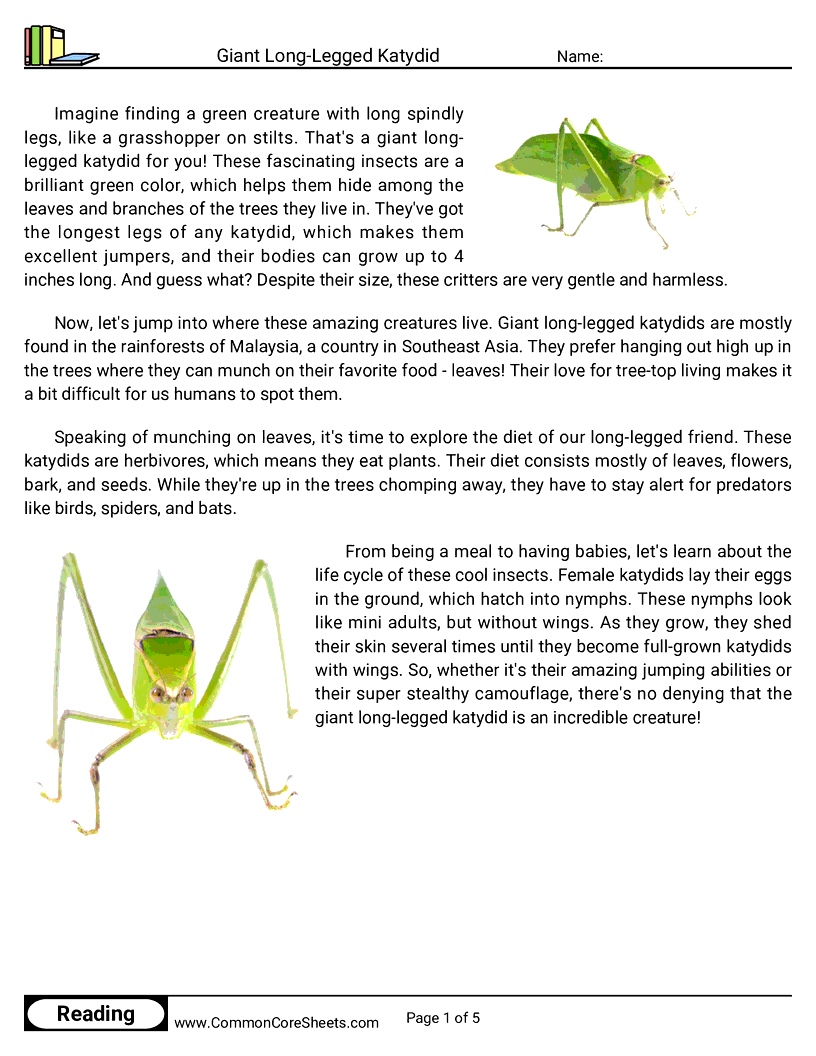
Imagine finding a green creature with long spindly legs, like a grasshopper on stilts. That's a giant long-legged katydid for you! These fascinating insects are a brilliant green color, which helps them hide among the leaves and branches of the trees they live in. They've got the longest legs of any katydid, which makes them excellent jumpers, and their bodies can grow up to 4 inches long. And guess what? Despite their size, these critters are very gentle and harmless.
Now, let's jump into where these amazing creatures live. Giant long-legged katydids are mostly found in the rainforests of Malaysia, a country in Southeast Asia. They prefer hanging out high up in the trees where they can munch on their favorite food - leaves! Their love for tree-top living makes it a bit difficult for us humans to spot them.
Speaking of munching on leaves, it's time to explore the diet of our long-legged friend. These katydids are herbivores, which means they eat plants. Their diet consists mostly of leaves, flowers, bark, and seeds. While they're up in the trees chomping away, they have to stay alert for predators like birds, spiders, and bats.
From being a meal to having babies, let's learn about the life cycle of these cool insects. Female katydids lay their eggs in the ground, which hatch into nymphs. These nymphs look like mini adults, but without wings. As they grow, they shed their skin several times until they become full-grown katydids with wings. So, whether it's their amazing jumping abilities or their super stealthy camouflage, there's no denying that the giant long-legged katydid is an incredible creature!
Meet the Giant Long-Legged Katydid, a fascinating insect that you may not have heard of before. These insects are known for their extraordinarily long legs and unique appearance. They belong to the family Tettigoniidae and are also called bush crickets. Let\'s explore more about this amazing creature!
Giant Long-Legged Katydids are found mainly in the rainforests of Central and South America. They prefer to live in the dense, humid forest canopies where they can easily camouflage themselves among the leaves and branches. Their green color and leaf-like shape help them blend in with their surroundings, making it difficult for predators to spot them. This habitat provides them with plenty of food and protection.
The life cycle of a Giant Long-Legged Katydid starts with an egg, which hatches into a nymph. The nymph looks similar to the adult but without wings and is smaller in size. As it grows, it goes through several molting stages, shedding its exoskeleton each time, until it reaches adulthood. Adults can live up to a year, depending on the environment and availability of food.
These amazing insects have a unique relationship with humans and other insects. Although they may look scary, they are actually harmless to humans and are rarely seen due to their excellent camouflage. They are predators and primarily eat small insects like aphids, which makes them beneficial for the ecosystem by controlling pest populations. Their main defense mechanism is their ability to blend in with their environment and avoid being detected by predators.
There are a few differences between Giant Long-Legged Katydids and other katydid species. Firstly, their long legs are much more pronounced than in other species, giving them their distinct appearance. Secondly, they are usually larger than other katydids, with some reaching up to 4 inches in length. Lastly, their antennae are much longer than their body, which helps them detect vibrations and movements of nearby insects.
So, now you know all about the fascinating Giant Long-Legged Katydids and how they play an important role in our ecosystem. Remember, even the smallest creatures can make a big difference in our world!
Meet the Giant Long-Legged Katydid, one of the coolest insects you\'ll ever learn about! They are also known as Macrolyristes corporalis and are part of the Tettigoniidae family. These fascinating creatures are known for their long legs, which can be twice as long as their body! Their bodies are usually green, and they have leaf-like wings that help them blend in with their surroundings. Some even have bright pink, yellow or orange markings on their bodies.
Giant Long-Legged Katydids love to eat plants and other insects. They are omnivores, which means they eat both plants and animals. Their diet consists mainly of leaves, flowers, fruits, and sometimes even small insects like caterpillars. This helps them get all the nutrients they need to grow and stay healthy. They are also known to eat their own molted skin to regain some of the nutrients they lost during the molting process.
These fascinating insects can be found in the tropical rainforests of Southeast Asia. They love to hang out in trees and bushes, where they blend in perfectly with their surroundings. Their long legs help them climb and navigate through their environment with ease. They prefer warm and humid conditions, which is why they thrive in rainforests. In some cases, they can also be found in people\'s gardens and parks.
Giant Long-Legged Katydids have a unique life cycle that is interesting to learn about. They start out as eggs, which are laid on leaves or stems by the female. After a few weeks, the eggs hatch into tiny nymphs, which look like smaller versions of the adult katydids. As they grow, they go through a series of molts, shedding their old skin and growing a new one each time. Once they reach adulthood, they are ready to reproduce and continue the cycle.
These amazing insects have some interesting relationships with humans and other creatures. While they are not considered pests, they can sometimes damage plants by eating their leaves. However, they also help control some pests by eating smaller insects that can harm plants. In addition, they are a food source for other animals like birds, bats, and spiders. Overall, the Giant Long-Legged Katydid plays an important role in the ecosystem and is a fascinating creature to learn about.
About this worksheet
Students read an informational passage about the giant long-legged katydid and answer questions about its features, habitat, and behavior.
This worksheet is designed to enhance children's reading skills, focusing on the Giant Long-Legged Katydid. It includes 20 comprehensive questions ranging from the Katydid's diet, habitat, reproduction to physical characteristics. This versatile worksheet can be customized, converted into flashcards, or utilized in distance learning settings to accommodate various teaching strategies and learning styles.
Student objectives
- Read a nonfiction passage about an unusual insect and understand the main ideas
- Find specific facts in the text, like where katydids live and what they eat
- Learn new vocabulary related to insects and their bodies
- Answer questions using details from what you read
Everyday practice
- Read a fact sheet at a zoo or insect exhibit and explain what you learned
- Look up information about a bug you found outside and describe it to someone
- Talk about interesting animal facts you read in a book or magazine
- Understand nature articles and answer questions about them