Giant Burrowing Cockroach Worksheet Download
Free reading worksheets on Giant Burrowing Cockroach. Each worksheet has 20 problems with an answer key and are ideal for teachers and homeschooling. You can download the PDF, create a set of flash cards or set it up for online learning.
Select a Different Activity
>


Sheet Information >
Available at 2nd grade, 3rd grade, 4th grade, 5th grade and 6th grade reading levels.
Read the passage
Let\'s learn about the fascinating Giant Burrowing Cockroach! These amazing insects can grow up to 3 inches long and can live for about 10 years. Did you know they are one of the heaviest cockroach species in the world, weighing up to 34 grams?
Now, let\'s talk about their interesting lifestyle. Giant Burrowing Cockroaches live in Australia and prefer to stay underground in burrows, where they eat dead leaves and plants. They are great friends to humans because they help recycle plant material and don\'t carry any diseases.
Lastly, let\'s explore their unique characteristics and how they interact with other insects. Unlike other cockroach species, they don\'t have wings and are not considered pests. Their main defense is their strong exoskeleton, which protects them from predators like birds and lizards.
In conclusion, Giant Burrowing Cockroaches are remarkable creatures that play an important role in their environment. Their unique features and benefits to humans make them an interesting species to learn about.
Meet the Giant Burrowing Cockroach, one of Australia\'s unique insects! These fascinating creatures can grow up to 3 inches long and are known for being the heaviest cockroach species in the world. They live mainly in the dry forests and grasslands of Australia, hiding and burrowing in the soil to stay safe from predators. Their brown, oval-shaped bodies help them blend in with their surroundings.
Now let\'s explore their diet and relationship with other insects. Giant Burrowing Cockroaches are vegetarian, munching on dead leaves and plant material found in their environment. They play an important role in breaking down plant matter and recycling nutrients back into the soil. These gentle giants are not aggressive towards humans, and they don\'t carry diseases or harm our homes like some other cockroach species.
Finally, let\'s learn about their life cycle and unique features. Female Giant Burrowing Cockroaches give birth to live young, called nymphs, instead of laying eggs like most insects. Nymphs go through several stages of growth, shedding their outer skin as they grow bigger. An interesting fact is that these cockroaches have no wings, so they rely on their strong legs for escaping danger.
In conclusion, the Giant Burrowing Cockroach is a fascinating and unique creature that plays an important role in Australia\'s ecosystem. By learning about these gentle giants, we can appreciate the diversity and wonder of nature.
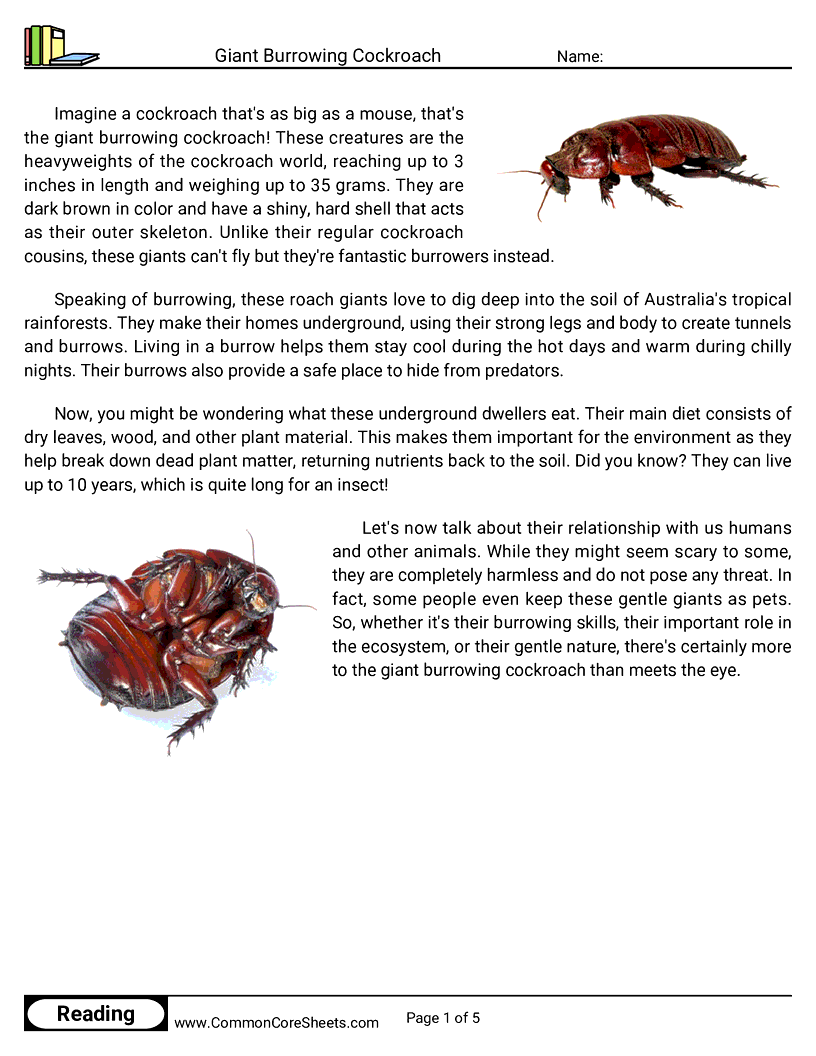
Imagine a cockroach that's as big as a mouse, that's the giant burrowing cockroach! These creatures are the heavyweights of the cockroach world, reaching up to 3 inches in length and weighing up to 35 grams. They are dark brown in color and have a shiny, hard shell that acts as their outer skeleton. Unlike their regular cockroach cousins, these giants can't fly but they're fantastic burrowers instead.
Speaking of burrowing, these roach giants love to dig deep into the soil of Australia's tropical rainforests. They make their homes underground, using their strong legs and body to create tunnels and burrows. Living in a burrow helps them stay cool during the hot days and warm during chilly nights. Their burrows also provide a safe place to hide from predators.
Now, you might be wondering what these underground dwellers eat. Their main diet consists of dry leaves, wood, and other plant material. This makes them important for the environment as they help break down dead plant matter, returning nutrients back to the soil. Did you know? They can live up to 10 years, which is quite long for an insect!
Let's now talk about their relationship with us humans and other animals. While they might seem scary to some, they are completely harmless and do not pose any threat. In fact, some people even keep these gentle giants as pets. So, whether it's their burrowing skills, their important role in the ecosystem, or their gentle nature, there's certainly more to the giant burrowing cockroach than meets the eye.
Meet the Giant Burrowing Cockroach, a fascinating insect that you might not have heard about before. These incredible creatures are native to Australia and are the world\'s heaviest species of cockroach. Unlike other cockroaches, they don\'t have wings and can\'t fly, but they make up for it with their unique burrowing skills. Let\'s dive into the world of these amazing insects and learn more about their lives, habits, and relationship with humans and other insects.
First, let\'s explore the habitat and diet of the Giant Burrowing Cockroach. They live in dry forests and woodlands, where they build intricate burrows in the soil. These burrows can be more than 1 meter deep and provide them with a safe and comfortable home. Giant Burrowing Cockroaches are detritivores, meaning they eat dead leaves, bark, and other plant materials, helping to recycle nutrients back into the soil.
Now let\'s take a closer look at the life cycle of these fascinating creatures. Giant Burrowing Cockroaches go through a process called incomplete metamorphosis, which includes three stages: egg, nymph, and adult. The female lays her eggs in her burrow, and after about three months, the nymphs hatch. These nymphs will grow and molt several times over the course of about a year before finally becoming adults, which can live up to ten years!
How do these insects interact with humans and other animals? Giant Burrowing Cockroaches are generally not considered pests because they don\'t invade human homes or spread diseases. Many people even keep them as pets because they are low-maintenance and interesting to observe. In the wild, they have a few predators like birds, reptiles, and other insects, but their burrowing habits and tough exoskeleton help protect them from danger.
Finally, let\'s discuss some interesting facts and differences between the Giant Burrowing Cockroach and other species. One unique feature of these cockroaches is their ability to produce a hissing sound by expelling air from their spiracles when threatened. This sound can startle predators and give the cockroach a chance to escape. Compared to other cockroach species, Giant Burrowing Cockroaches are much larger and heavier, with some individuals reaching up to 80 grams and 3.5 inches in length!
In conclusion, the Giant Burrowing Cockroach is a fascinating and unique insect that plays an important role in its ecosystem. With its intriguing life cycle, peaceful relationship with humans, and impressive size, it\'s no wonder that these creatures continue to captivate the curiosity of people all around the world.
Have you ever heard of Giant Burrowing Cockroaches? These fascinating insects are the world\'s heaviest cockroach species, and they can be found in Australia. They have a unique appearance, with a dark brown to black color, and can grow up to 3 inches in length. Unlike other cockroaches, they don\'t have wings, so they can\'t fly. Instead, they have strong legs that help them move around and burrow into the ground.
Giant Burrowing Cockroaches live in a very specific environment. They can be found in the forests of Eastern Australia, where they dig deep burrows in the soil. These burrows can be up to 1 meter in depth, and they provide a safe and cool home for the cockroaches. In their natural habitat, they share the area with other insects and animals, all living together in the ecosystem. They prefer to stay hidden during the day and become more active at night.
So, what do these giant insects eat? Their diet mainly consists of dried leaves and other plant materials. This makes them important for the environment, as they help break down and recycle dead plant matter. They have a unique relationship with other insects, as some species of beetles and mites live in the cockroach\'s burrow and help to clean it. In return, the beetles and mites get shelter and food from the cockroach\'s leftovers.
The life cycle of the Giant Burrowing Cockroach is quite interesting. Their life begins as an egg, which the female lays in a special chamber inside the burrow. After hatching, the baby cockroaches, called nymphs, grow and molt several times before reaching adulthood. Throughout their life, they continue to grow and shed their exoskeleton, which is their outer protective layer. These amazing insects can live up to 10 years, which is much longer than most other cockroach species.
Now, let\'s talk about their relationship with humans and their defenses. Giant Burrowing Cockroaches are considered harmless to humans and do not spread diseases like some other cockroach species. They have a defense mechanism called 'hisser,' which produces a loud hissing sound to scare off predators. Some people even keep them as pets, as they are easy to care for and have a low-maintenance diet. They are truly unique creatures, and their fascinating characteristics make them a great example of the incredible diversity of life on our planet.
About this worksheet
Students read a passage about the giant burrowing cockroach and answer comprehension questions about its habits, habitat, and traits.
This worksheet is designed to educate children on the fascinating life of the Giant Burrowing Cockroach. Covering areas such as the creature's size, weight, lifespan, habitat, and diet, the worksheet offers 20 interactive multiple-choice reading problems. The engaging educational material can be customized to suit individual learning styles, converted into flash cards for more playful studying, or utilized effectively in a distance learning setup.
Student objectives
- Read a nonfiction passage about an unusual insect and understand the main idea
- Find specific facts and details in the text to answer questions
- Learn new vocabulary related to insects and their habitats
- Explain what makes the giant burrowing cockroach different from other insects
Everyday practice
- Read a fact card at a zoo or insect exhibit and understand what it says
- Look up information about an animal you're curious about
- Tell a family member interesting facts you learned from a book
- Answer questions about a nature show or magazine article you just watched or read