Eastern Coral Snake Worksheet Download
Free reading worksheets on Eastern Coral Snake. Each worksheet has 20 problems with an answer key and are ideal for teachers and homeschooling. You can download the PDF, create a set of flash cards or set it up for online learning.
Select a Different Activity
>
Sheet Information >
Available at 2nd grade, 3rd grade, 4th grade, 5th grade and 6th grade reading levels.
Read the passage
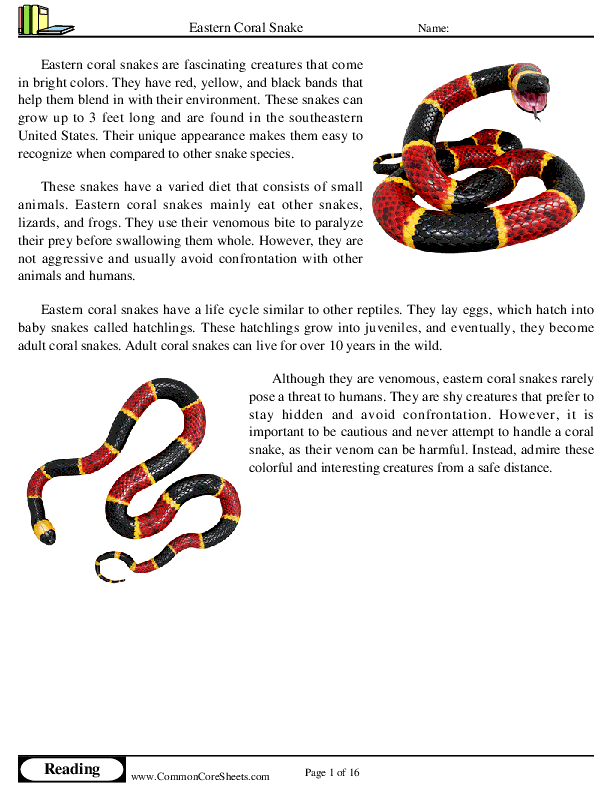
Let\'s learn about the eastern coral snake, a colorful and interesting creature! They are mostly found in the southeastern parts of the United States, including Florida, Georgia, and the Carolinas. Eastern coral snakes have a beautiful pattern of red, yellow, and black bands, which can help you recognize them easily.
Eastern coral snakes have a fascinating life cycle and eating habits. They love to eat other small animals like lizards, frogs, and even other snakes! These snakes lay eggs, and when the baby snakes hatch, they\'re already around 8 inches long and ready to start their own adventures.
It\'s important to know how eastern coral snakes interact with humans and other animals. While they are venomous, they are shy and prefer to stay away from people, so it\'s rare for them to bite humans. Remember to admire these beautiful creatures from a safe distance and let them live peacefully in their natural habitats.
In this article, we\'ve learned about the eastern coral snake\'s appearance, where they live, what they eat, and their life cycle. We\'ve also discussed their relationship with humans and other animals, and the importance of respecting their space. So, next time you see an eastern coral snake, remember to enjoy their beauty from a safe distance and let them continue their fascinating lives in the wild.
Meet the eastern coral snake, a fascinating creature with bright colors and interesting patterns. These snakes can be found in the southeastern United States, living in forests, swamps, and even your backyard! They\'re usually about two feet long and have red, yellow, and black bands around their bodies, which help them blend in with their surroundings. But don\'t be fooled by their pretty appearance, as they are known to be venomous and should be respected from a distance.
Eastern coral snakes have a unique life cycle and eating habits that make them different from other snakes. They lay eggs instead of giving live birth, and the eggs hatch after about two months. These snakes are carnivorous, which means they eat other animals, and their favorite meal is other snakes, especially the venomous ones! Their relationship with other animals can be a little tricky, as they can be both predator and prey.
Although eastern coral snakes may seem scary, they can be helpful to humans too. They help control the population of other venomous snakes, such as rattlesnakes and copperheads, which can be dangerous to people. However, it\'s essential to remember that eastern coral snakes are venomous, so if you ever come across one, it\'s best to leave it alone and let it go on its way. Overall, eastern coral snakes are fascinating animals that play an important role in our ecosystem.
Imagine a snake with a body so brightly colored, it looks like it's wearing a party costume! This is the Eastern Coral Snake, a small, thin snake with a head that barely stands out from its body. Its skin is covered with a pattern of red, yellow, and black bands that make it one of the most recognizable snakes in the world. But don't let its festive look fool you, this snake has a serious side too.
Speaking of serious, when it comes to mealtime, the Eastern Coral Snake is all business. Its favorite foods are small lizards and other snakes, which it catches using its short, fixed front fangs. The Eastern Coral Snake is a connoisseur of the 'grab-and-hold' style of dining, which means it holds onto its food while injecting it with venom. Even though this might sound scary, it is just part of how the Eastern Coral Snake survives in the wild.
This wild habitat of theirs is mostly in the southeastern United States. They like to live in forested or marshy areas where they can hide under leaf litter or in burrows. Eastern Coral Snakes are oviparous, which means they lay eggs, with the babies, called hatchlings, born fully formed. These hatchlings grow into adults who shed their skin several times a year, a process known as molting.
Now, you might be thinking, 'Do Eastern Coral Snakes and humans get along?' Well, they are shy and prefer to avoid humans, but if they feel threatened, they can bite to defend themselves. Their venom is very potent, but bites are rare because these snakes would rather hide or run away. In nature, every creature has its place, and for the Eastern Coral Snake, that place is being a quiet, colorful part of the world's amazing biodiversity.
Meet the eastern coral snake, a colorful and fascinating reptile! This snake is known for its vibrant colors, which are red, yellow, and black bands. The bands can help you identify it, as they say, 'red and yellow, kill a fellow; red and black, venom lack'. This means that if the red and yellow bands touch, it\'s an eastern coral snake.
These snakes have a unique habitat, living mostly in the southeastern United States. They can be found in Florida, Georgia, and other nearby areas. They like to live in forests, under leaves, and in burrows made by other animals. You might even find them hiding in your backyard, but they are pretty shy and good at hiding.
Eastern coral snakes have a fascinating life cycle and eating habits. They lay eggs, which hatch into baby snakes after about 70 days. These little snakes love to munch on other reptiles, like lizards and even other snakes! Sometimes, they eat frogs and small mammals, too.
While they may look pretty, it\'s important to know that eastern coral snakes can be dangerous to humans and other animals. They have a powerful venom that can be harmful if they bite. However, they are usually not aggressive and will only bite if they feel threatened. It\'s best to admire their beauty from a distance and let them be.
Finally, here are some interesting facts and differences between eastern coral snakes and other species. Firstly, their venom is different from other venomous snakes in the US, as it\'s a neurotoxin which can affect the nervous system. Also, they are related to the cobra family, which makes them different from other North American snakes. These snakes may be small, but they are unique and play an important role in our ecosystem.
Eastern coral snakes are fascinating creatures found in the southeastern United States. They have a beautiful and distinctive pattern of red, yellow, and black bands, which warns predators that they are venomous. These snakes are relatively small, usually growing to be about 2 feet long. Though they may be small, they have a powerful neurotoxic venom that can be very dangerous to humans and other animals. However, eastern coral snakes are shy and would rather avoid confrontation if possible.
Eastern coral snakes have a unique diet, mostly eating other reptiles. Their favorite foods include lizards, frogs, and smaller snakes, including other coral snakes. Using their venom, they can quickly subdue and digest their prey. Since they eat other venomous snakes, they play an essential role in controlling the snake population in their habitat. They are also known to eat small rodents and birds occasionally.
The life cycle of an eastern coral snake is quite interesting. During mating season, which is usually in the spring, males will search for females to mate with. After mating, the female will lay between 3 and 12 eggs, which she will hide in moist, warm areas like rotting logs or leaf litter. The eggs will incubate for about 10 to 12 weeks before the baby snakes, called hatchlings, emerge. Eastern coral snakes can live up to 7 years in the wild.
While eastern coral snakes are dangerous to humans, they generally avoid contact. Bites are rare and usually happen when someone accidentally steps on or touches the snake. If bitten, it is vital to seek immediate medical attention, as their venom can be life-threatening. However, these snakes play an important role in their ecosystem by controlling the populations of other reptiles and rodents. It\'s important to respect and admire these snakes from a safe distance.
Eastern coral snakes are just one of several species of coral snakes found around the world. There are more than 65 different species, and they can be found in North, Central, and South America, as well as Asia. Not all coral snakes have the same color patterns, but they all have venomous bites. A helpful rhyme to remember when identifying eastern coral snakes is 'red touches yellow, kill a fellow; red touches black, friend of Jack.' This rhyme helps distinguish eastern coral snakes from non-venomous lookalikes, like the scarlet king snake.
Remember to always admire and respect eastern coral snakes from a safe distance, and appreciate the important role they play in our ecosystem.
About this worksheet
Students read an informational passage about the eastern coral snake and answer comprehension questions about its features, habitat, and behavior.
This worksheet is designed to enhance children's reading and comprehension with engaging content about the Eastern Coral Snake. It presents 20 multiple-choice questions that explore the snake's behavior, habitat, diet and unique characteristics. The worksheet is customizable, suitable for creating flashcards, and can be used for distance learning providing an effective educational tool.
Student objectives
- Read a nonfiction passage and understand the main ideas
- Find and recall facts about the eastern coral snake
- Answer questions using details from the text
- Learn new vocabulary about snakes and their traits
- Tell the difference between the coral snake and similar species described in the text
Everyday practice
- Read a sign or brochure about local wildlife at a park or zoo
- Identify a snake you see outside using facts you've learned
- Explain to a friend why some snakes are dangerous
- Look up an animal in a book or online and pull out key facts
- Understand safety warnings about venomous animals when hiking or camping