Home Favorites My Account Menu
login
Playwire Advertisement

Crane Flies Worksheet Download

Free reading worksheets on Crane Flies. Each worksheet has 20 problems with an answer key and are ideal for teachers and homeschooling. You can download the PDF, create a set of flash cards or set it up for online learning.

Select a Different Activity >
Sheet Information >
Crane Flies
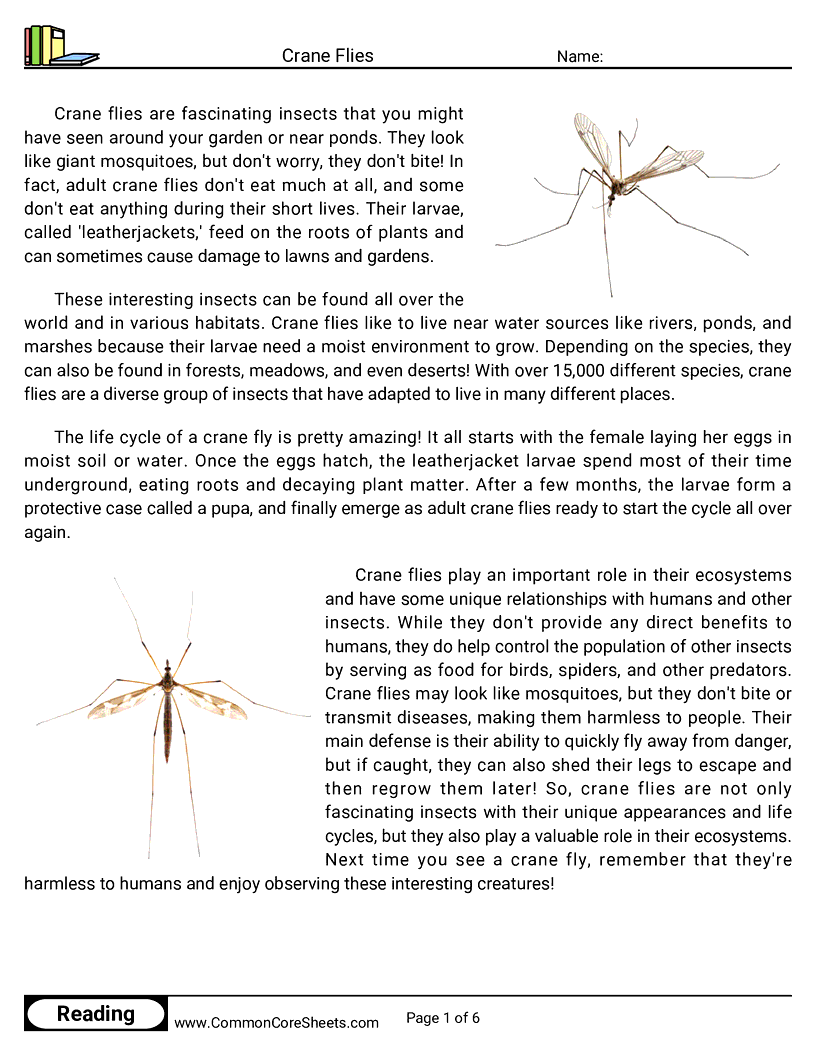
Students read an informational passage about crane flies and answer comprehension questions about the facts presented.
Crane Flies worksheet preview
Crane Flies worksheet
Open PDF
Customize preview
open in new window
Select Worksheet
pages
Select Problem Type
Customize Problems
×
Problem type
Save
Sheet Layout>
Seed
title
Instructions
Number of Problems
Due Date
Include standard on Sheet
Font
Font Size pt
Minimum Space Below Problems mm
Answer Column
Problem Number
sheet orientation

Available at 2nd grade, 3rd grade, 4th grade, 5th grade and 6th grade reading levels.

Read the passage
Reading level:

Crane flies are fascinating insects that you might have seen around your garden or near ponds. They look like giant mosquitoes, but don't worry, they don't bite! In fact, adult crane flies don't eat much at all, and some don't eat anything during their short lives. Their larvae, called 'leatherjackets,' feed on the roots of plants and can sometimes cause damage to lawns and gardens.

These interesting insects can be found all over the world and in various habitats. Crane flies like to live near water sources like rivers, ponds, and marshes because their larvae need a moist environment to grow. Depending on the species, they can also be found in forests, meadows, and even deserts! With over 15,000 different species, crane flies are a diverse group of insects that have adapted to live in many different places.

The life cycle of a crane fly is pretty amazing! It all starts with the female laying her eggs in moist soil or water. Once the eggs hatch, the leatherjacket larvae spend most of their time underground, eating roots and decaying plant matter. After a few months, the larvae form a protective case called a pupa, and finally emerge as adult crane flies ready to start the cycle all over again.

Crane flies play an important role in their ecosystems and have some unique relationships with humans and other insects. While they don't provide any direct benefits to humans, they do help control the population of other insects by serving as food for birds, spiders, and other predators. Crane flies may look like mosquitoes, but they don't bite or transmit diseases, making them harmless to people. Their main defense is their ability to quickly fly away from danger, but if caught, they can also shed their legs to escape and then regrow them later! So, crane flies are not only fascinating insects with their unique appearances and life cycles, but they also play a valuable role in their ecosystems. Next time you see a crane fly, remember that they're harmless to humans and enjoy observing these interesting creatures!

About this worksheet

Students read an informational passage about crane flies and answer comprehension questions about the facts presented.

This worksheet is designed to boost children's reading and comprehension skills through exploring the subject of crane flies. It comprises 20 multifaceted questions about the insect’s behavior, habitat, physical characteristics, and impact on the environment. The informative content can be customized, converted into flashcards, and be effectively used for distance learning to facilitate diverse pedagogical methods.

Student objectives

  • Read a nonfiction passage about crane flies
  • Find and recall details from what you read
  • Answer questions using information from the text
  • Understand new facts about a type of insect

Everyday practice

  • Read an article about an animal and remember the key facts
  • Look up information about a bug you find outside
  • Explain to someone what you learned from something you read
  • Answer questions a friend asks about a nature article
Playwire Advertisement