Cicadas Worksheet Download
Free reading worksheets on Cicadas. Each worksheet has 20 problems with an answer key and are ideal for teachers and homeschooling. You can download the PDF, create a set of flash cards or set it up for online learning.
Select a Different Activity
>


Sheet Information >
Available at 2nd grade, 3rd grade, 4th grade, 5th grade and 6th grade reading levels.
Read the passage
Cicadas are fascinating insects that you might hear buzzing loudly during the summer months. These cool creatures can be found all over the world, living in trees and bushes. Cicadas are pretty big for insects, with some species growing up to 2 inches long and having wingspans of up to 4 inches.
The life cycle of a cicada is really interesting, as they spend most of their lives underground. After hatching from eggs, young cicadas called nymphs burrow into the ground and feed on plant roots for many years. When they\'re finally ready, they emerge from the ground, shed their exoskeleton, and become adults with wings!
Cicadas are not harmful to humans and can actually be helpful in some ways. Their loud singing can be a natural pest deterrent, scaring away other insect pests. Plus, cicadas are an important food source for many animals like birds and reptiles.
In conclusion, cicadas are fascinating insects with unique life cycles and interesting relationships with humans and other creatures.
Cicadas are fascinating insects that create a unique buzzing sound. They are mostly found in warm environments like forests, gardens, and parks, living in trees and bushes. Cicadas have a special mouthpart called a 'proboscis' to suck plant sap, which is their primary food source. These amazing creatures come in many sizes, with some as small as 1 inch and others reaching up to 2 inches in length.
The life cycle of a cicada is quite interesting. They start as eggs, which the female cicada lays in tree branches, and then hatch into tiny nymphs. Nymphs live underground, feeding on plant roots, and go through several stages of development before emerging as adult cicadas. Depending on the species, cicadas can spend anywhere from 2 to 17 years underground before they\'re ready to come out!
Cicadas have quite a few unique features that set them apart from other insects. Their loud buzzing sound is actually a defense mechanism to scare away predators like birds and other insects. Cicadas are generally harmless to humans, and some people even consider their loud songs to be a pleasant part of warm summer evenings. There are over 3,000 species of cicadas in the world, each with their own distinct characteristics and song patterns.
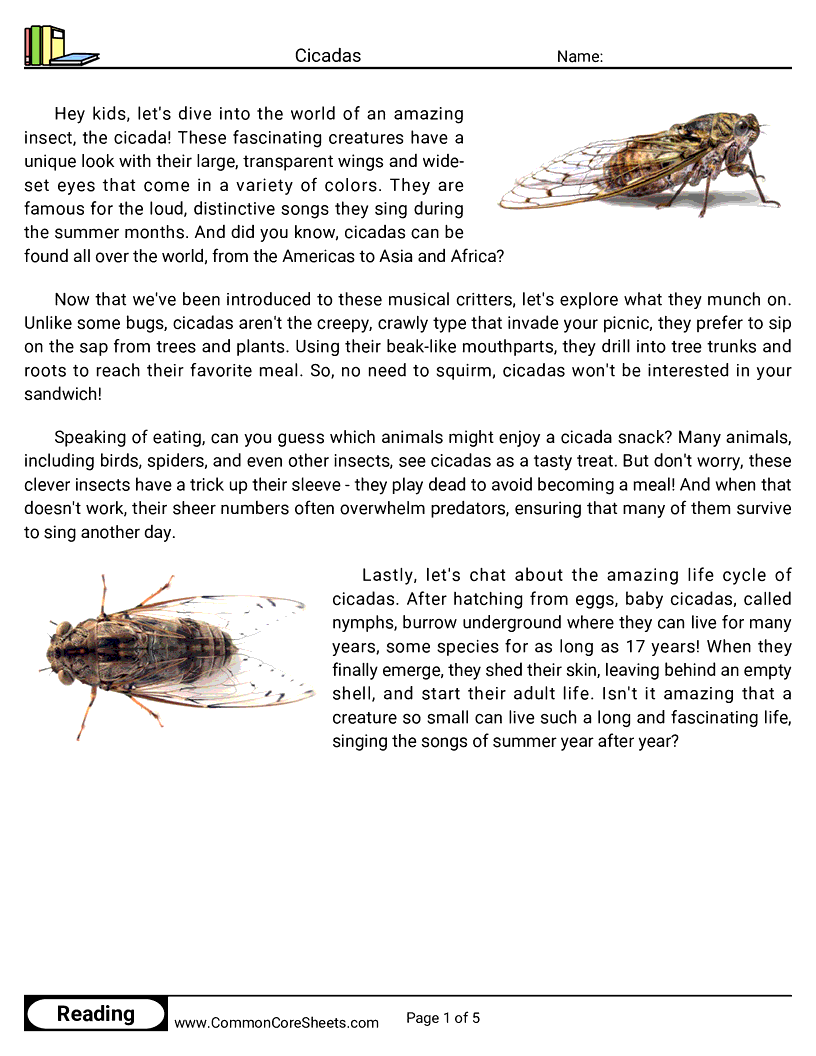
Hey kids, let's dive into the world of an amazing insect, the cicada! These fascinating creatures have a unique look with their large, transparent wings and wide-set eyes that come in a variety of colors. They are famous for the loud, distinctive songs they sing during the summer months. And did you know, cicadas can be found all over the world, from the Americas to Asia and Africa?
Now that we've been introduced to these musical critters, let's explore what they munch on. Unlike some bugs, cicadas aren't the creepy, crawly type that invade your picnic, they prefer to sip on the sap from trees and plants. Using their beak-like mouthparts, they drill into tree trunks and roots to reach their favorite meal. So, no need to squirm, cicadas won't be interested in your sandwich!
Speaking of eating, can you guess which animals might enjoy a cicada snack? Many animals, including birds, spiders, and even other insects, see cicadas as a tasty treat. But don't worry, these clever insects have a trick up their sleeve - they play dead to avoid becoming a meal! And when that doesn't work, their sheer numbers often overwhelm predators, ensuring that many of them survive to sing another day.
Lastly, let's chat about the amazing life cycle of cicadas. After hatching from eggs, baby cicadas, called nymphs, burrow underground where they can live for many years, some species for as long as 17 years! When they finally emerge, they shed their skin, leaving behind an empty shell, and start their adult life. Isn't it amazing that a creature so small can live such a long and fascinating life, singing the songs of summer year after year?
Cicadas are fascinating insects that have a unique life cycle and interesting features. These insects are known for their loud singing, which can be heard during the warm summer months. Cicadas have large, transparent wings and big, bulbous eyes that give them a distinctive appearance. There are more than 3,000 species of cicadas around the world, and they can be found on every continent except for Antarctica.
Cicadas are known for their interesting life cycle, which includes spending most of their lives underground as nymphs. When they are ready to emerge, they dig their way to the surface and shed their exoskeleton to become adults. Depending on the species, cicadas can spend anywhere from 2 to 17 years underground before emerging. Once they become adults, cicadas have a short lifespan, living only for a few weeks to mate and lay eggs.
Cicadas have a unique diet, as they mainly feed on the sap of trees and plants. While they are underground, cicada nymphs use their straw-like mouthparts to suck nutrients from plant roots. Adult cicadas also feed on plant sap, but they don\'t cause much harm to the plants they feed on. In fact, they can be beneficial to the environment by helping to aerate the soil and recycle nutrients when they die.
Humans and other animals have interesting relationships with cicadas. Some people around the world even consider cicadas a delicacy and eat them as a food source. Cicadas are also important for the ecosystem, as they provide food for many birds, small mammals, and other insects. Their loud singing, however, can be a nuisance for humans during the summer months.
Cicadas have developed some unique defenses and differences compared to other insects. Their loud singing can help deter predators by making it difficult to locate an individual cicada. Cicadas also emerge in large numbers, which can overwhelm predators and increase the chances of survival for the individuals. The long period of time cicadas spend underground helps to protect them from predators and allows them to avoid competition with other insects for resources.
In conclusion, cicadas are truly amazing insects with their unique life cycle, diet, and adaptations. Their intriguing characteristics make them an interesting subject to learn about for people of all ages, including 11-year-olds.
Cicadas are fascinating insects that you might have seen or heard in your backyard or while exploring the outdoors. These insects are known for their unique appearance, with transparent wings and big, round eyes. They come in various colors, such as green, black, and brown, and can be found on every continent except Antarctica. Cicadas belong to the Hemiptera order, which also includes bugs such as aphids and leafhoppers. In this article, we\'ll dive into the world of cicadas, learning about their diet, habitat, life cycle, and more.
First, let\'s talk about what cicadas eat and where they live. These insects primarily feed on the sap from plants, trees, and shrubs. Using their straw-like mouthparts called proboscises, they pierce the plant\'s tissue and suck out the sap. Cicadas can be found living in various environments, such as forests, grasslands, and even urban areas with abundant greenery. Their adaptability allows them to thrive in different climates and habitats all around the world.
Next, we\'ll explore the unique life cycle of cicadas. Cicadas start their lives as eggs, which are laid by females in tree branches or twigs. Once the eggs hatch, tiny nymphs emerge and fall to the ground, where they burrow into the soil and live for several years. After this period, the nymphs crawl out of the ground, molt into adults, and start the cycle all over again. Some cicada species, known as periodical cicadas, have a synchronized life cycle and emerge in massive numbers every 13 or 17 years.
Now, let\'s discuss cicadas' relationship with humans and other insects. Although cicadas are harmless to humans and don\'t bite or sting, their loud mating calls can sometimes be annoying. They also play an important role in the ecosystem by providing food for various predators, such as birds, rodents, and even other insects. Cicadas are also beneficial to the environment by aerating the soil when they burrow as nymphs. Furthermore, their emergence in large numbers provides a natural form of pest control for trees, as they consume weaker and dying branches.
Lastly, we\'ll explore some interesting facts and differences between cicada species. There are more than 3,000 known species of cicadas, and they vary in size, color, and life cycle duration. The loudest cicada species can produce a sound of up to 120 decibels, which is as loud as a rock concert or a chainsaw. Cicadas' main defense mechanism is their loud noise, which can deter or confuse potential predators. In some cultures around the world, cicadas are also considered a delicacy and are consumed as a source of protein.
About this worksheet
Students read a passage about cicadas and answer questions to show their understanding of the text.
This worksheet is designed to enlighten children on the intriguing world of cicadas. Covering key concepts like their colorful eyes, predators, global habitats, unique life cycle, and survival tactics, it offers 20 immersive reading problems. This flexible, educational tool can be customized to facilitate various learning modes including flashcards and distance learning, optimizing engagement and comprehension.
Student objectives
- Read a nonfiction passage about cicadas and understand the main ideas
- Find and recall specific facts from the text
- Answer questions using details from what you read
- Learn new information about insects and their life cycles
Everyday practice
- Understand a magazine or web article about an animal you're curious about
- Explain to a friend what cicadas are and why they make noise
- Answer questions about something you just read in a science book
- Spot key facts when reading a nature sign at a park or zoo