Bald Eagle Worksheet Download
Free reading worksheets on Bald Eagle. Each worksheet has 20 problems with an answer key and are ideal for teachers and homeschooling. You can download the PDF, create a set of flash cards or set it up for online learning.
Select a Different Activity
>


Sheet Information >
Available at 2nd grade, 3rd grade, 4th grade, 5th grade and 6th grade reading levels.
Read the passage
"Have you ever seen a bald eagle soaring high in the sky?" These magnificent birds are not really bald, but have white feathers on their heads that make them look bald against their dark brown bodies. Bald eagles are different from other birds because they have a sharp beak and large talons, which they use to catch their favorite food, fish.
"Let's talk about where bald eagles live and their life cycle." Bald eagles are found in North America, making their homes near bodies of water where they have plenty of fish to eat and tall trees to nest in. They lay 1 to 3 eggs each year, and both the mom and dad take turns keeping the eggs warm until they hatch.
"Now, let's explore how bald eagles interact with humans and other animals." In the past, bald eagles were hunted by humans, but now they are protected by law and their numbers are growing. They are a symbol of strength and freedom, and we should always respect and protect these wonderful creatures.
"Hey there, have you ever seen a bald eagle soaring high in the sky?" "Bald eagles are really big, in fact, they're one of the largest birds of prey in North America!" "They're not actually bald, they just have white feathers on their heads which make them look that way." "You can spot them by their broad wings, brown bodies and the white feathers on their heads and tails."
"Now let's talk about where they live and what they eat." "Bald eagles live near rivers, lakes, and marshes where they can find their favorite food, fish." "They have sharp talons to catch their prey and a strong beak to tear their food into smaller pieces." "Sometimes, they also eat small mammals, birds, and even carrion (dead animals)."
"Bald eagles have a very interesting life cycle and relationship with us humans and other animals." "They mate for life and build huge nests called aeries in tall trees or on cliffs where they raise their eaglets." "To humans, bald eagles are a symbol of strength and freedom, and to other animals, they are top predators in their ecosystem." "So, remember, whenever you see a bald eagle, you're looking at one of nature's most majestic creatures!"
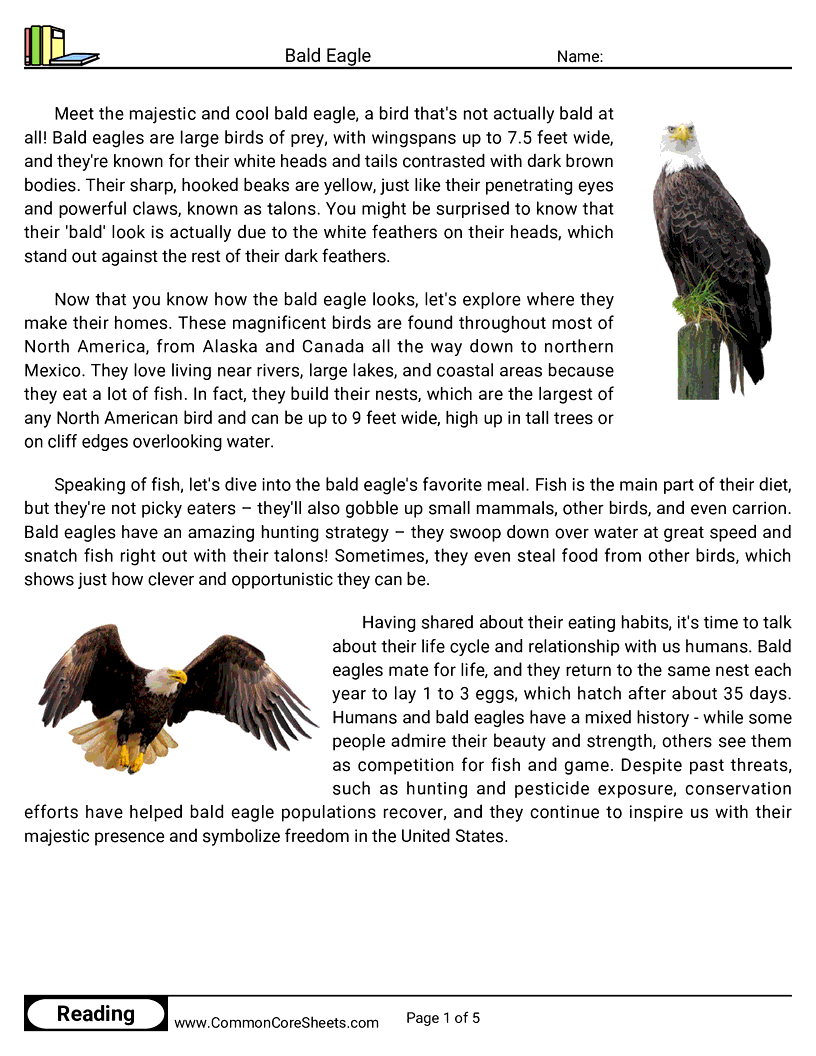
Meet the majestic and cool bald eagle, a bird that's not actually bald at all! Bald eagles are large birds of prey, with wingspans up to 7.5 feet wide, and they're known for their white heads and tails contrasted with dark brown bodies. Their sharp, hooked beaks are yellow, just like their penetrating eyes and powerful claws, known as talons. You might be surprised to know that their 'bald' look is actually due to the white feathers on their heads, which stand out against the rest of their dark feathers.
Now that you know how the bald eagle looks, let's explore where they make their homes. These magnificent birds are found throughout most of North America, from Alaska and Canada all the way down to northern Mexico. They love living near rivers, large lakes, and coastal areas because they eat a lot of fish. In fact, they build their nests, which are the largest of any North American bird and can be up to 9 feet wide, high up in tall trees or on cliff edges overlooking water.
Speaking of fish, let's dive into the bald eagle's favorite meal. Fish is the main part of their diet, but they're not picky eaters – they'll also gobble up small mammals, other birds, and even carrion. Bald eagles have an amazing hunting strategy – they swoop down over water at great speed and snatch fish right out with their talons! Sometimes, they even steal food from other birds, which shows just how clever and opportunistic they can be.
Having shared about their eating habits, it's time to talk about their life cycle and relationship with us humans. Bald eagles mate for life, and they return to the same nest each year to lay 1 to 3 eggs, which hatch after about 35 days. Humans and bald eagles have a mixed history - while some people admire their beauty and strength, others see them as competition for fish and game. Despite past threats, such as hunting and pesticide exposure, conservation efforts have helped bald eagle populations recover, and they continue to inspire us with their majestic presence and symbolize freedom in the United States.
"Let's dive into the fascinating world of bald eagles!" Bald eagles aren't actually bald; instead, they're named for their distinctive white-feathered heads that contrast with their brown bodies. They're pretty big for birds, with a wingspan reaching up to 8 feet and weighing between 6.5 to 14 pounds. Bald eagles are unique to North America, making them quite special among other species.
"Now, let's explore where these magnificent birds make their homes." Bald eagles prefer locations near water, like lakes, rivers, marshes, and coasts, where they can hunt for their favorite food: fish. Their nests, known as aeries, are built high in trees or on cliff faces, and are among the largest bird nests in the world. They usually return to the same nest during breeding season, adding more materials each year.
"What do bald eagles eat, you might ask?" Their diet primarily consists of fish, but they won't say no to small mammals, birds, and even carrion (that's dead animals!). Bald eagles are known for their extraordinary eyesight, which they use to spot prey from high up in the sky. Once they've spotted their next meal, they swoop down and grab it with their sharp talons.
"Let's take a look at the life cycle of a bald eagle." After hatching from their eggs, bald eagles are called eaglets and stay in the nest for about 12 weeks. As they grow older, they learn to fly and hunt, eventually leaving their parents' territory to start their own families. Did you know? Bald eagles can live up to 20 years in the wild!
"Finally, let's talk about bald eagles' relationship with humans and other animals." Humans and bald eagles have had a complicated relationship, with the eagles being hunted and their habitats destroyed, leading to their endangerment in the past. But thanks to conservation efforts, their numbers have bounced back, and they're not considered endangered anymore! As for other animals, bald eagles are at the top of the food chain, but they do have to watch out for larger predators like bears and wolves.
"Hello, friends! Let's talk about the amazing bald eagles, the national bird of the United States." "These majestic creatures are not actually bald; their name comes from an old English word 'balde', which means white, referring to their white heads." "Bald eagles are quite large, with a wingspan ranging from 6 to 8 feet." "They have a sharp, yellow beak and powerful talons to help them hunt." "Their striking appearance, with a white head and tail contrasted with a dark brown body, makes them easy to identify."
"Now, let's explore where these magnificent birds live." "Bald eagles are found throughout most of North America, from Alaska and Canada to northern Mexico." "They prefer to live near rivers, lakes, and marshes where they can find plenty of fish to eat." "They build their nests, called aeries, high in tall trees or on cliff edges." "Aeries can be up to 8 feet wide and weigh up to a ton!"
"Bald eagles have a fascinating life cycle and eating habits." "They mainly eat fish, but they are opportunistic feeders and also eat smaller birds, rodents, and even carrion." "Eagles mate for life and usually lay one to three eggs each year." "The eggs hatch in about 35 days, and the eaglets stay in the nest for 10 to 12 weeks." "Eagles can live up to 20 years in the wild."
"Bald eagles have a unique relationship with humans and other animals." "They are at the top of their food chain and have no natural predators." "Humans, however, have caused harm to eagles through habitat destruction, hunting, and pollution." "Thanks to conservation efforts, the bald eagle population has significantly recovered from the brink of extinction." "They are now a symbol of successful wildlife protection."
"Finally, let's take a look at how bald eagles differ from other species and some interesting facts." "Unlike other eagle species, bald eagles prefer to hunt during the day and are known for their spectacular aerial displays." "Did you know that the sound commonly attributed to bald eagles in movies is actually the call of a red-tailed hawk? Bald eagles have a more chirpy call." "Bald eagles are also known for their 'death spiral' behavior, where two eagles lock talons in mid-air and spin as they fall towards the ground, releasing just before impact." "Isn't it fascinating to learn about these incredible creatures? Remember, we each play a part in ensuring their survival."
About this worksheet
Students read a passage about the bald eagle and answer questions about its habitat, diet, appearance, and role as a national symbol.
This worksheet is designed to enhance children's reading comprehension skills, focusing on the topic of the Bald Eagle. It presents 20 interactive multiple-choice questions covering key facts about bald eagles, from their unique hunting abilities to their symbolic significance in the United States. This versatile resource can be customized, converted into flashcards for reinforcement or conveniently used in distance learning settings.
Student objectives
- Read a nonfiction passage about bald eagles and understand the main ideas
- Find specific facts in the text to answer questions
- Learn key details about the bald eagle's diet, habitat, and appearance
- Understand why the bald eagle is an American symbol
Everyday practice
- Recognize the bald eagle when you see it on coins, stamps, or government buildings
- Point out a bald eagle if you spot one while hiking or near a lake
- Talk about what makes the bald eagle special during a trip to a zoo or nature center
- Explain to a friend why the bald eagle stands for the United States