Home Favorites My Account Menu
login
Playwire Advertisement

Australian Walking Stick Worksheet Download

Free reading worksheets on Australian Walking Stick. Each worksheet has 20 problems with an answer key and are ideal for teachers and homeschooling. You can download the PDF, create a set of flash cards or set it up for online learning.

Select a Different Activity >
Sheet Information >
Australian Walking Stick
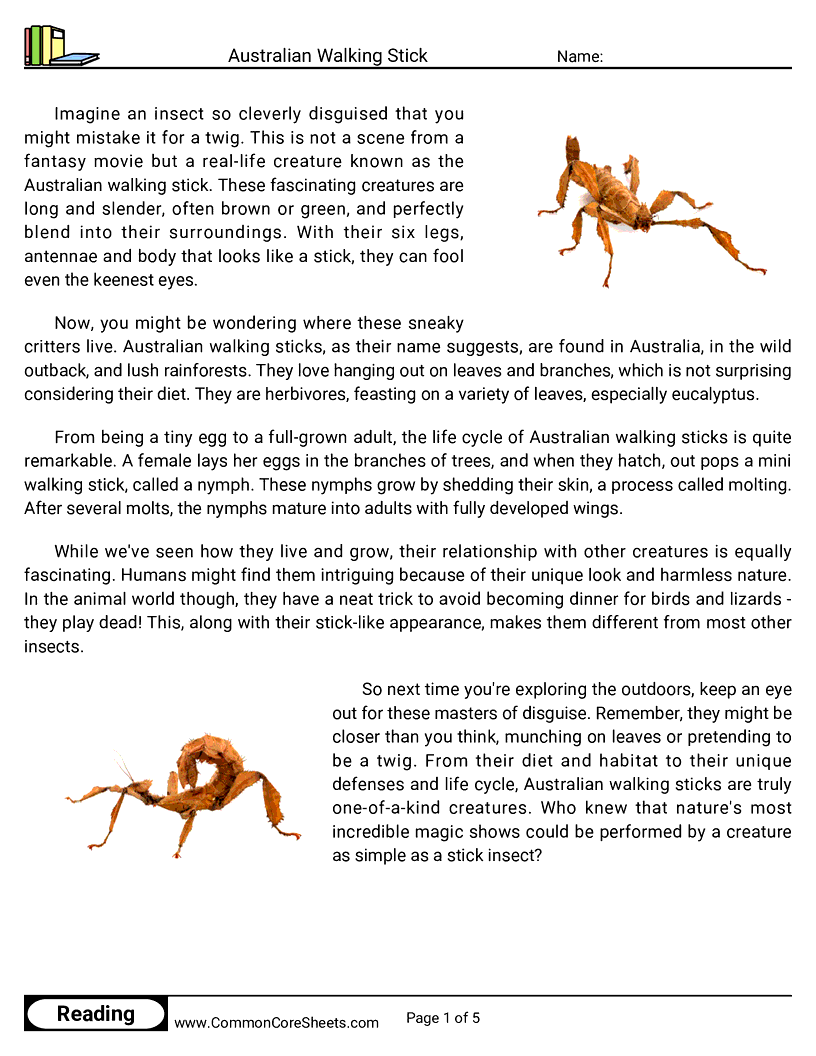
Students read a nonfiction passage about the Australian walking stick insect and answer comprehension questions about its traits and habits.
Australian Walking Stick worksheet preview
Australian Walking Stick worksheet
Open PDF
Customize preview
open in new window
Select Worksheet
pages
Select Problem Type
Customize Problems
×
Problem type
Save
Sheet Layout>
Seed
title
Instructions
Number of Problems
Due Date
Include standard on Sheet
Font
Font Size pt
Minimum Space Below Problems mm
Answer Column
Problem Number
sheet orientation

Available at 2nd grade, 3rd grade, 4th grade, 5th grade and 6th grade reading levels.

Read the passage
Reading level:

Imagine an insect so cleverly disguised that you might mistake it for a twig. This is not a scene from a fantasy movie but a real-life creature known as the Australian walking stick. These fascinating creatures are long and slender, often brown or green, and perfectly blend into their surroundings. With their six legs, antennae and body that looks like a stick, they can fool even the keenest eyes.

Now, you might be wondering where these sneaky critters live. Australian walking sticks, as their name suggests, are found in Australia, in the wild outback, and lush rainforests. They love hanging out on leaves and branches, which is not surprising considering their diet. They are herbivores, feasting on a variety of leaves, especially eucalyptus.

From being a tiny egg to a full-grown adult, the life cycle of Australian walking sticks is quite remarkable. A female lays her eggs in the branches of trees, and when they hatch, out pops a mini walking stick, called a nymph. These nymphs grow by shedding their skin, a process called molting. After several molts, the nymphs mature into adults with fully developed wings.

While we've seen how they live and grow, their relationship with other creatures is equally fascinating. Humans might find them intriguing because of their unique look and harmless nature. In the animal world though, they have a neat trick to avoid becoming dinner for birds and lizards - they play dead! This, along with their stick-like appearance, makes them different from most other insects.

So next time you're exploring the outdoors, keep an eye out for these masters of disguise. Remember, they might be closer than you think, munching on leaves or pretending to be a twig. From their diet and habitat to their unique defenses and life cycle, Australian walking sticks are truly one-of-a-kind creatures. Who knew that nature's most incredible magic shows could be performed by a creature as simple as a stick insect?

About this worksheet

Students read a nonfiction passage about the Australian walking stick insect and answer comprehension questions about its traits and habits.

This worksheet is designed to enhance children's reading skills with a focus on the Australian Walking Stick. It features 20 interactive questions covering key concepts including its appearance, life cycle, habitat, and diet. This customizable worksheet can be easily converted into flashcards, making it a versatile tool for both in-person and distance learning.

Student objectives

  • Read a short informational text about the Australian walking stick insect
  • Find key facts and details in the passage
  • Understand how the insect uses camouflage to survive
  • Answer questions using information from the reading

Everyday practice

  • Read a fact sheet at the zoo about an insect you see
  • Look up details about a bug you find in the backyard
  • Talk about how animals hide from predators when watching a nature show
  • Pull out important facts when reading an animal book
Playwire Advertisement