Associative Property - Multiple Choice Worksheet Download
Free 3rd Grade (3oa5) math worksheets on Finding Associative Property of Multiplication . Each worksheet has 12 problems with an answer key and are ideal for teachers and homeschooling. You can download the PDF, create a set of flash cards or set it up for online learning.
Select a Different Activity
>


Sheet Information >
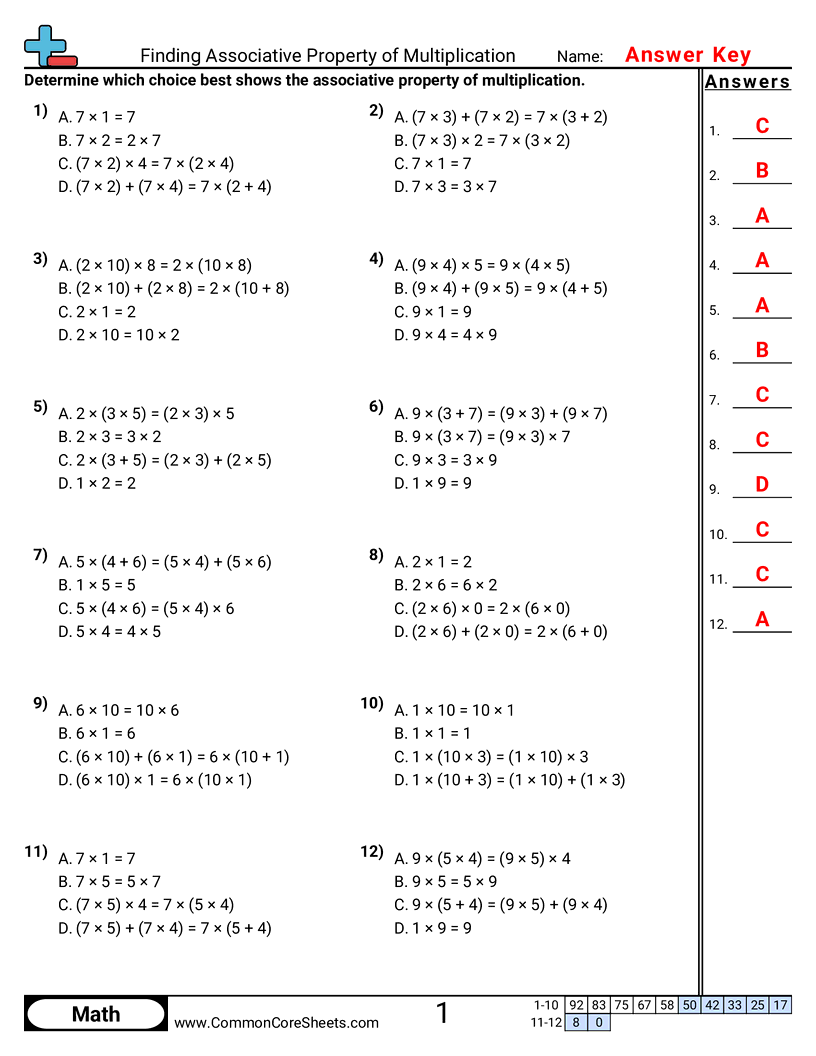
About this worksheet
Each Worksheet has 12 multiple choice problems identifying the Associative Property of Multiplication.
This worksheet is designed to help children grasp the concept of Associative Property of Multiplication through 12 engaging math problems. Explaining varying ways of multiplication reordering without changing the result, this customized tool can be converted into flashcards or used in distance learning environments. Featuring problems such as '0 × 1 = 1 × 0' and '3 × (4 + 10) = (3 × 4) + (3 × 10)', it's a versatile resource in enhancing kids' mathematical skills.
Student objectives
- Recognize when a multiplication equation is using the associative property by changing how the factors are grouped.
Everyday practice
- Figuring out the total number of snacks when there are several bags with the same number of packs and each pack has the same number of pieces.
- Counting how many seats are in a section when rows are grouped into blocks and each row has the same number of seats.
- Calculating how many trading cards you have when packs are bundled together and each pack has the same number of cards.
- Finding the total number of tiles in a floor area when tiles are arranged in equal rows and columns and you group rows into sections.