8ee6×Description:
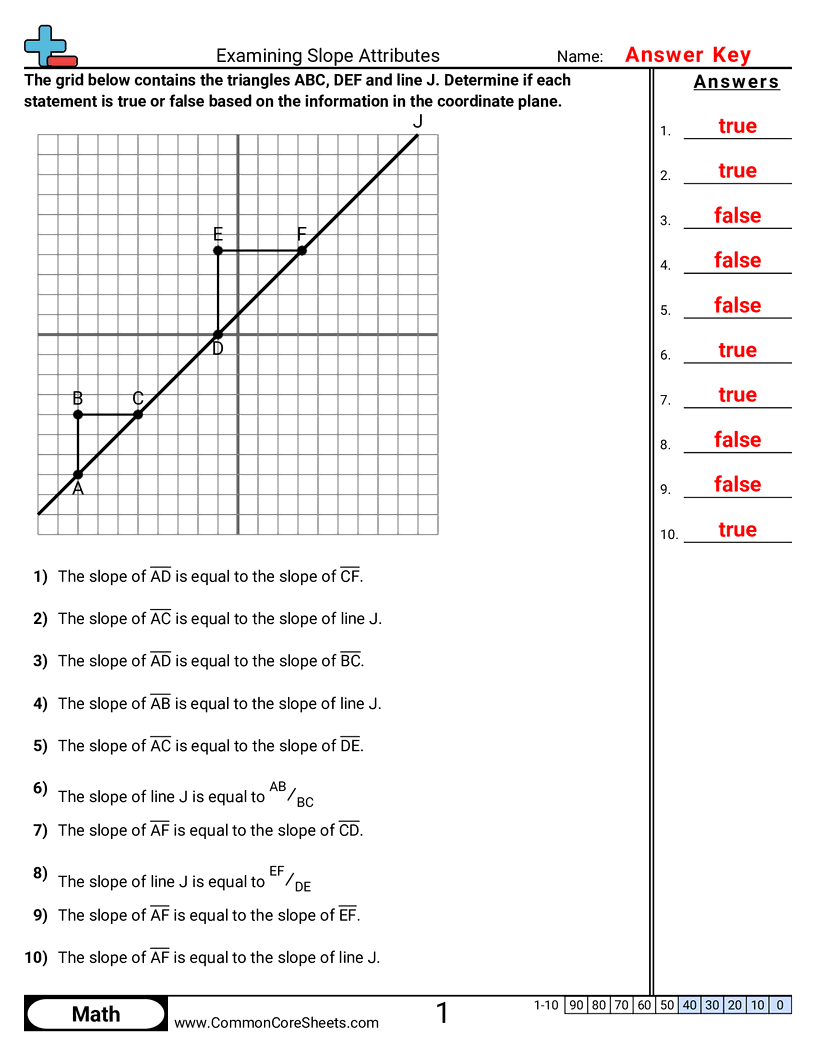
"This worksheet is designed to guide children through the concept of examining slope attributes in mathematics. With a total of 10 problems, it challenges students to determine and compare the slopes of different lines. This flexible learning tool can be customized to each student's needs, and content can be converted into flashcards for further study. Ideal for distance learning, the worksheet advances understanding of key math concepts related to slopes in geometry."
×Student Goals: Understanding of Slope ConceptAfter successfully completing this worksheet, students should have an enhanced understanding of the slope concept. They will grasp the mathematical notion of slope in relation to lines in a two-dimensional space. This foundational comprehension will enable pupils to navigate more complex geometry and algebraic problems with ease.Problem Solving SkillsThis worksheet elevates learners' ability to solve mathematical problems related to slope. They will adeptly determine whether two lines have the same slope and interpret meaning from given equation parameters, thereby strengthening their problem-solving and critical thinking skills.Skill in Equation ManipulationCompleting the worksheet will improve students' ability to manipulate mathematical equations, particularly those involving the slope of lines. Practice with slope equations will encourage accuracy and precision in students' mathematical language and equation solving.Increased Comfort in GeometryThis worksheet serves to increase students' comfort in the subject of geometry, specifically regarding lines and angels. They will develop proficiency in handling geometrical problems involving slopes, a central concept in geometry which serves as a stepping stone for grasping higher-level geometrical concepts.Mathematical ConfidenceFinally, by completing this worksheet, students will boost their mathematical confidence. Handling these 10 problems and building their intuition around slope, they thereby enhance their self-confidence in confronting new mathematical problems. This positive attitude is critical for the ongoing study of mathematics and sets them up for future success.