Home
Favorites
My Account
Menu
Common Core Sheets
Math
Spelling
Create-A-Review
Create-A-Test
Create-A-Sheet
improving a paragraph
login
x
reading
>
Daily Reading Comprehension
New
comprehension - insects
comprehension - arachnids
comprehension - reptiles
comprehension - mammals
comprehension - birds
Teacher Panel
>
My Account
Distance Learning Assignments
My Classes
Grade Book
Grade Scale
My Created Sheets
Site Options
Spelling
>
Spelling Worksheets Maker
Spelling List Generator
New
User Spelling Lists
Math
>
Daily Reviews Creator
Create-A-Test
Create-A-Flash Card
Sort By Grade
Addition
Subtraction
Multiplication
Division
Algebra
Angles
Area & Perimeter
Balancing Equations
Bar Graphs
Box Plots
Capacity
Cheat Sheets
Converting Forms
Counting
Decimals
Division
Drills
Fact Families
Factors
Fractions
Grids
Lines
Line Graphs
Line Plots
Mean, Median, Mode & Range
Measurement
Money
Multiplication
Multistep Problems
Negative Numbers
Order of Operations
Patterns & Function Machines
Percent
Pictographs
Pie Graphs
Probability
Properties
Ratios
Rounding
Shapes
Statistics
Subtraction
Tally
Tape Diagrams
Temperature
Time
Trigonometry
Value & Place Value
Variables
Weight
Venn Diagrams
Volume
Drills
Search Premade Sheets
social studies
>
Geography
Primary & Secondary Sources
Timelines
Create-A-Sheet
science
>
Tools
Volume
Create-A-Sheet
Language Arts
>
Improving a Paragraph
Coloring Pages
>
Easter
New
Teacher Panel
>
My Account
Distance Learning Assignments
My Classes
Grade Book
Grade Scale
My Saved Sheets
Site Options
Languages
>
spanish
german
russian
italian
vietnamese
french
english
Help Support the Site
>
Patreon
Paypal
Other Stuff
>
How to Use Worksheets
Contact & Comment
Home
Math Worksheets
Decimal Worksheets
Converting A Decimal To Percent (Less than 1)
Like
Playwire Advertisement
Converting A Decimal To Percent (Less than 1)
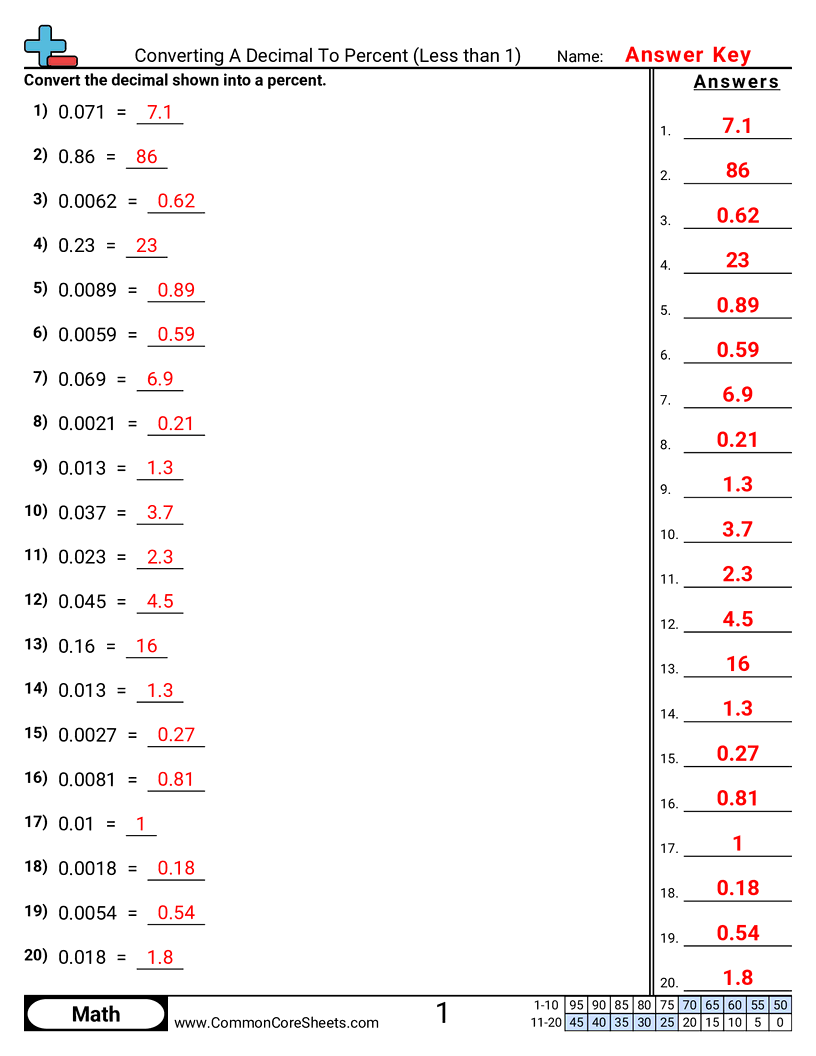
Each worksheet has 20 problems converting from a decimal to a percent with a number less than 1.
Worksheet
One Atta Time
Flash Cards
Distance Learning
Create New Sheet
Student Objectives
Practice turning a decimal less than 1 into a percent.
Learn to multiply a decimal by 100 to find the percent.
Get comfortable moving the decimal point two places to the right when converting to percent.
Write the final answer correctly using the percent sign (%)
Tags
numeric
horizontal
converting forms
decimals
Standards
Playwire Advertisement